Union Finance Minister Nirmala Sitharaman announced a package for micro, small & medium enterprises (MSMEs), covering financing, regulatory changes and technology support to help them grow and compete globally.
For facilitating term loans to MSMEs for purchase of machinery and equipment without collateral or third-party guarantee, the Budget announced a credit guarantee scheme.
“The scheme will operate on pooling of credit risks of such MSMEs. A separately-constituted self-financing guarantee fund will provide to each applicant guarantee cover up to Rs 100 crore, while the loan amount may be larger. The borrower will have to provide an upfront guarantee fee and an annual guarantee fee on the reducing loan balance,” Sitharaman added.
The Budget also announced a new mechanism for facilitating continuation of bank credit to MSMEs during their stress period. “While being in the ‘special mention account’ (SMA) stage for reasons beyond their control, MSMEs need credit to continue their business and avoid getting into the non-performing assets (NPA) stage. Credit availability will be supported through a guarantee from a government-promoted fund,” she said.
SMA is a classification banks use to identify loans showing signs of stress before turning into bad debts.
Ashok Saigal, co-chairman of MSME committee of the Confederation of Indian Industry (CII) said all the credit lines dry up once the SME becomes SMA.
“Even if they have a chance of recovery after that, it remains a constraint for obtaining further funding from the bank. Temporary support during the difficult period can help them return to health, even if the difficulty is due to delayed payments or a temporary downturn in business,” Saigal added.
Sitharaman also tasked public sector banks to develop a new credit assessment system based on the scoring of digital footprints of MSMEs instead of relying on external assessments.
“This is expected to significantly improve the traditional assessment of credit eligibility based only on asset or turnover criteria. It will also cover MSMEs without a formal accounting system,” she added.
The finance minister has also increased the limit of Mudra loans to Rs 20 lakh from the current Rs 10 lakh for those entrepreneurs who have availed and successfully repaid previous loans under the ‘Tarun’ category. Tarun is the highest category under Mudra, so far covering loans above Rs 5 lakh and up to Rs 10 lakh.
The FM also said the government plans to set up e-commerce export hubs in a private-public partnership (PPP) mode to help small businesses and traditional artisans sell their products in international markets.
Moreover, to facilitate MSMEs in unlocking their working capital by converting their trade receivables into cash, the FM proposed reducing the turnover threshold of buyers for mandatory onboarding on the Trade Receivables electronic Discounting System (TReDS) platform from Rs 500 crore to Rs 250 crore.
According to the finance minister, this measure will bring 22 more central public sector enterprises (CPSEs) and 7,000 more companies onto the platform. Medium enterprises will also be included in the scope of suppliers.
She also announced that the Small Industries Development Bank of India (Sidbi) will open new branches to expand its reach to serve all major MSME clusters within three years.
With the opening of 24 such branches this year, the service coverage will expand to 168 out of 242 major clusters.
Additionally, financial support will be provided for setting up 50 multi-product food irradiation units in the MSME sector.
The establishment of 100 food quality and safety testing labs with National Accreditation Board for Testing and Calibration Laboratories (NABL) accreditation will also be facilitated.
THE WORLD’S A STAGE
- Mudra limits for MSMEs doubled
- FM tasked public sector banks to have in-house capability to assess MSMEs for credit
- FM proposed reducing turnover threshold of buyers for mandatory onboarding TReDS platform from Rs 500 crore to Rs 250 crore

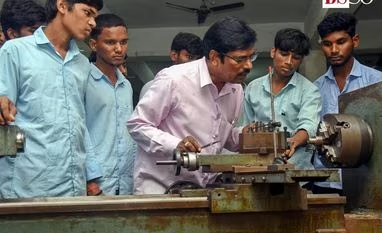 "Budget 2024-25: Credit support for MSMEs to help them compete globally")


 Connect with us on WhatsApp