Essar group will turn the UK's Stanlow refinery into the world's first decarbonised green refinery as it plans to use blue hydrogen for meeting heating and power needs of the unit, cutting carbon emissions by as much as 95 per cent, a top official said Tuesday.
Speaking at FT's Energy Transition Summit India, Prashant Ruia, director of Essar Capital, which manages the group's portfolio of investments, said Essar Energy Transition's (EET) HyNet project will produce 350-megawatt of blue hydrogen in phase-1 and another 1 gigawatt in phase-II.
Since the UK does not have solar and wind potential to produce renewable electricity which could be used to split water in an electrolyser to produce green hydrogen and oxygen, EET will use natural gas to produce blue hydrogen and also capture and permanently store carbon produced during the process.
"We are going to make this (Stanlow) the world's first decarbonised green refinery. We are decarbonising 95 per cent of our carbon dioxide (CO2)" emissions that are released when crude oil is processed into fuels like petrol and diesel, he said.
Use of blue hydrogen in the refinery process will decarbonise up to 2.5 million tonnes of CO2 - equivalent to taking 1.1 million cars off the roads.
"Using hydrogen for the refinery heating and power requirement will be first globally," he said.
Last week, the UK government announced 21.7 billion pounds of funding over 25 years to support the construction of two carbon capture clusters in northern England that include large blue hydrogen projects. The money will be for the HyNet hub in Merseyside and the East Coast Cluster hubs in Teesside, which will see more than 8.5 million tonnes of carbon dioxide a year stored under the Irish Sea and North Sea.
EET is piloting the HyNet project.
Decarbonising the refinery would improve its profitability as the company would no longer have to pay carbon tax, he said.
Besides decarbonising its oil refinery in the UK, the conglomerate, which turned debt-free in 2022, is looking to construct a green steel plant in Saudi Arabia, and build an LNG and electric ecosystem to decarbonise long-haul heavy trucks.
Essar Future Energy, a part of EET, will develop 1 gigawatt of hydrogen capacity along with associated green molecules capacity of 1 million tonne per annum in Jamnagar in Gujarat over the next four years.
In the realm of green mobility solutions, Essar is focused on building an LNG and electric ecosystem to decarbonise long-haul heavy trucks, contributing to a cleaner transportation sector, Ruia said.
It has a fleet of 500 LNG-powered trucks that are used by different industries for their logistics needs, he said, adding that the plan is to add 20,000-30,000 trucks in a few years.
Trucks are the biggest polluters on the road, producing some 110 tonnes of carbon dioxide per truck. There are 4 million trucks in the country and the number is slated to double in the near future.
Replacing diesel in trucks with LNG helps cut CO2 emissions by 30-35 per cent. Also, gas does not produce nitrogen oxides (NOx) and sulfur oxides (SOx) which cause acid rain and air pollution.
The 4 million trucks emit 400 million tonnes of CO2, which is 18 per cent of India's carbon emissions, he said.
Alongside, the group also has a fleet of electric trucks.
Emissions from electric vehicles are zero.
Essar is also building a retail network to supply liquefied natural gas (LNG) to trucks, he said, adding that LNG-powered trucks can run for 1,400 kilometres on a full tank while electric trucks have a range of around 150 km.
"So short-range is electric and longer range can be LNG," he said.
Essar had previously stated that it plans to invest $ 3.6 billion to decarbonise its Stanlow refinery in the UK and another $ 4 billion to set up a green steel plant, which will use hydrogen, in Saudi Arabia.


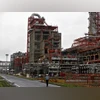 "Essar aims to turn Stanlow into world's 1st decarbonised green refinery")

