Nestlé India, the maker of Maggi noodles and KitKat, has seen a change in the corner officer after a decade. Manish Tiwary, chairman and managing director, speaks with Akshara Srivastava about his vision for the fast-moving consumer goods (FMCG) major, the changes he hopes to drive, and the company’s growth vectors. Edited excerpts:
You have returned to the FMCG world after an almost decade-long stint at Amazon. How has the landscape changed from your time at Unilever?
I’ve spent almost the entirety of the last decade watching the rise of direct-to-consumer brands. Fifteen years ago, creating a national brand within five years would have been impossible. Distribution was a massive challenge and building brand awareness was gigantic and expensive. Brands could be popular in a region, city, or state, but not necessarily nationwide. That’s no longer the case.
India is a vibrant market, so we have to think like a startup. Today, consumption patterns are different. Households don’t stick to one brand. Each member may choose a different product for the same category — shampoo or noodles, for instance. Consumers are more aware, and they have greater spending power. The only way to win them is to offer a compelling proposition.
How are you working towards growth in this landscape? Does it mean a larger focus on e-commerce and quick commerce (qcom)?
One big learning from Amazon is how technology can make us faster and more efficient. We are brand owners, so we must serve consumers through whichever route-to-market emerges. Qcom players have innovated well to meet consumer gaps, and they play an important role in our premiumisation agenda.
It’s important to learn from the outside and bring that learning in. We are a ₹20,077.5 crore company, profitable, with distribution, scale, and strong brands. We can be flexible as long as we stay open to innovating for the consumer.
Today, every GenZ consumer reads the back of the pack — that’s a big shift. It’s not just about route-to-market or channel; it’s about ensuring product quality even as we reduce sodium or sugar. That’s where research and development (R&D) builds customer trust.
You mentioned using technology more effectively. How will it help Nestlé India?
I’ve introduced several changes on the technology front, and the 8,629 people who work here have been open to adopting them. This will give us the fuel to invest more behind brands, drive rural penetration, and push premium products.
Philipp (Navratil, chief executive officer, Nestlé SA) calls it the virtuous circle: use technology, drive optimisation, reinvest into the consumer — through brands, pricing, or people. That’s the way I see it.
By the end of the year, we will be fully digitised — from supply planning to distribution. Once something is sold, the system feeds it into a forecasting model for factory planning, production planning, and raw-material sourcing.
Being fast, focused, and flexible is good intent, but it needs to become a deliberate practice. As that takes root, we’ll be able to respond better to growth, regional opportunities, and rural penetration.
How is the rural market evolving, and how do you plan to strengthen your rurban strategy?
Our rural contribution is about 15 per cent. For many large consumer packaged goods players, that number is 40–60 per cent. Rural markets have grown nearly twice as fast as urban in the past two years, reflecting rising income and consumption.
I’m excited about rural — low base, strong brands, and a solid distribution setup. We currently have 31,000 distribution touchpoints.
Traditionally, rurban meant rural + urban mega clusters with similar consumption patterns. We have always been strong in urban, then we went deeper into rurban, and now we are entering pristine rural.
Coverage can be a vanity metric; what matters is robustness. With technology, I believe we’re positioned to capture the growth emerging from these markets.
Does this include inorganic growth? Have you identified white spaces?
We have our core businesses like Maggi and Lactogen, and emerging brands like Nespresso or Purina — all addressing specific needs.
I see white canvases, not just white spaces. There’s plenty of headroom. We can gain a lot simply by driving penetration in core and emerging categories.
That said, we’ll consider opportunities where relevant. Nestlé SA invested in pet-food brand Drools, so yes, we will look at such options. But we don’t want distractions — we are decades away from saturation in most categories.
What is your vision for the company?
If you look at the Nestlé per-capita consumption, India is among the lowest globally — that alone shows the growth runway. We’ve invested nearly ₹3,900 crore in capital expenditure in the last two financial years. We have R&D, technology, and the brand portfolio to power ahead. I’m focused on the global strategy of the virtuous circle. No change in strategy, just keep it simple and execute well.
So, keeping on the flywheel of technology, consumer centricity, and cost optimization, we will drive volume-led growth and results.

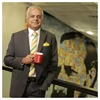 "India a very vibrant market, have to think like startup: Nestle India CMD")











