Evonik working on biodegradable composites for medical implants
German firm is conducting research on new biodegradable composite materials for the fixation of fractured bones that will degrade naturally in the body
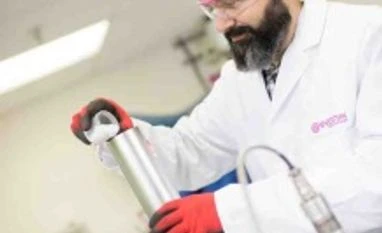
An employee filling in extruder with polymer granulate
Evonik is conducting research into biodegradable high-strength composites, which could potentially replace metal in implants used for the internal fixation of fractured bones.
Implants play a key role in supporting bones until they heal. Today’s metallic devices typically remain in the body for the rest of the patient’s life or require additional surgery for removal. By contrast, devices made with Evonik’s new composites will be absorbed by the body gradually once the bone healing process has taken place. These materials consist of polymers and of substances that naturally occur in bones. Evonik’s research is still in its early stages - however, the possible benefits for patients are already clear. Patients will no longer need to undergo additional surgical procedures to remove the implanted devices. Specific device designs may also help bones regenerate faster.
The project is one of a number currently being conducted at the Medical Devices Project House in Birmingham, Alabama, USA, which employs a team of more than 20 experts. Its mission is to develop new medical technology solutions and materials, with a particular emphasis on implants.
Dr Andreas Karau, head of the Project House, explains the researchers’ vision, “In the long term, our focus is regenerative medicine. We want to create bioabsorbable implants to replace damaged tissues with healthy tissues. Our current work on biodegradable composites is a first step in this direction.”
There is a significant need for high-strength biodegradable materials. The number of implants required for the fixation of bone fractures is substantial: osteoporosis, for example, is responsible for 8.9 million fractures every year. Additionally, the Euro 300-billion global medical technology market is growing at around six percent annually. The US commands the largest share of the global market by far, with 40 percent. Moreover, American companies are major players in implant technology. Other key medical technology markets include Europe and Japan.
“Our leading position in polylactic acid-based polymers is an excellent foundation for the development of materials and solutions for regenerative medicine,” explained Karau. The polymers break down into carbon dioxide and water. Degradation time depends on their molecular composition, chain length, and crystallinity. They can last from a few weeks to many months - providing plenty of time for bones or other tissues to regenerate.
Medical device manufacturers use Resomer polymers marketed by Evonik’s healthcare business line to make bioabsorbable screws, pins and small plates. These are primarily used for torn ligaments in the knee or shoulder, and for fixation of smaller bones in fingers or the face.
However, as Karau noted, “At the moment, the materials we have available are not strong enough to be used for large, load-bearing bones.” Consequently, the researchers at Medical Devices Project House are exploring composite materials that reinforce biodegradable polymers with inorganic substances, such as derivatives of calcium phosphate. Not only do these additives strengthen the material, they enhance its biocompatibility. “As the polymers gradually break down, calcium and phosphate can be absorbed into the newly formed bone tissue,” explained Karau.
Moreover, the researchers’ vision goes even further. With the right materials, they could harness 3D printing to create made-to-measure implants for individual patients. One of the goals of Evonik’s researchers in Birmingham is to make its biodegradable polymers suitable for this additive manufacturing process.
Karau added, “In the long term, we intend to develop polymeric scaffolds that could be colonised with living cells - creating a true biological implant.” This approach would make it possible to regenerate cartilage, for example - or to replace damaged heart tissue with healthy tissue. However, the researchers must first find ways to improve the materials’ biocompatibility.

 "Evonik working on biodegradable composites for medical implants")


 Connect with us on WhatsApp