Prime Minister Narendra Modi on Sunday urged member countries of the Group of 20, or G20, to develop a global framework for talent mobility, and proposed a worldwide compact on artificial intelligence (AI).
Addressing the concluding session of the G20 summit in Johannesburg, marred by the boycott of the United States (US), Modi said the AI compact must provide for an effective human oversight and a strict ban on the use of AI for deepfakes, crime, and terrorism.
“AI systems that impact human life, security, or public trust must be responsible and auditable.”
Technological advancement was leading to opportunities and resources becoming increasingly concentrated in a few hands, he said, and this was an obstacle to innovation. He flagged that competition over critical technologies was intensifying around the world.
Modi stressed the need to promote technology applications that were “human-centric” rather than “finance-centric”, that are “global” rather than merely “national”, and that follow “open-source” models rather than “exclusive” ones.
“Development must be sustainable. Trade should be trusted. Finance must be fair. And progress must ensure all-inclusive prosperity,” he said.
Over two days of speeches and interactions with leaders, Modi spoke of the need for an inclusive world order in sharing technological advancement and supplying critical minerals.
On Saturday, Modi proposed setting up a “G20 critical minerals circularity initiative”, which could drive innovation such as recycling, urban mining, and second-life batteries. His suggestion has come in the context of India facing a shortage of supply in critical minerals from China.
G20 declaration
G20 leaders, despite US opposition, adopted a declaration that called for addressing the climate crisis and other global challenges. The declaration, drafted without inputs from the US, “can’t be renegotiated”, the spokesperson for South African President Cyril Ramaphosa told reporters.
Ramaphosa said the declaration reflected a “renewed commitment to multilateral cooperation”. Addressing the summit’s closing ceremony, he said the declaration showed that world leaders’ “shared goals outweigh our differences”.
Brazilian President Luiz Inacio Lula da Silva said the G20 summit and the United Nations climate conference (going on in Brazil) showed multilateralism was alive.
Hours after the declaration was adopted, the White House accused South Africa of having weaponised its G20 presidency to undermine the grouping’s founding principles as it pushed to issue a G20 Leaders’ Declaration “despite consistent and robust US objections”.
President Donald Trump looks forward to “restoring legitimacy” to the grouping next year, when the US holds its presidency, she said.
Apart from the US, Argentina, whose far-right President Javier Milei is a close ally of Trump, quit the negotiations right before the envoys were about to adopt the draft text. The mention of climate change in the declaration is being seen as a snub to Trump, who is a sceptic on the issue.
PM’s speeches
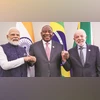
At the IBSA (India, Brazil, and South Africa) meeting, which the PM attended on Sunday, he pointed out the neither of its three members were part of the United Nations Security Council (UNSC), and said the body’s reform was no longer an option but a necessity. He proposed institutionalising an IBSA National Security Adviser-level meeting to strengthen security cooperation, setting up a “digital innovation alliance” and also a fund for climate resilient agriculture.
In his address at the second session, Modi also proposed setting up a G20 Open Satellite Data Partnership whereby satellite data and analysis from G20 space agencies could be made “more accessible for countries of the Global South”.
On AI, the PM said India would host the AI Impact Summit in February with the theme: Sarvajana Hitaya, Sarvajana Sukhaya (welfare for all, happiness for all). He said that while AI might enhance human capabilities, the ultimate responsibility for decision-making must always remain with human beings.
Modi announced a trilateral technology and innovation partnership among India, Australia, and Canada. According to a joint statement by the governments of India, Australia and Canada, the three sides agreed to “strengthen their ambition in cooperation on critical and emerging technologies to complement existing bilateral initiatives”. The initiative will draw on the natural strengths of the three countries and have an emphasis on green-energy innovation and building resilient supply chains.
In his speech at the inaugural session of the summit on Saturday, the PM proposed setting up a G20 initiative to counter the drug-terror nexus and a global health care response team.
The PM proposed the G20-Africa Skills Multiplier with a train-the-trainers approach across sectors, supported and financed by all the grouping’s partners, with the collective target to create one million certified trainers in Africa over the next decade, who will then help skill millions of young people.
During their bilateral talks, Ramaphosa told Modi in jest that “you should have told us that it (hosting the G20 summit) is such a difficult task, maybe we would have run away”. Ramaphosa said his country had learnt a lot from India about hosting the G20. “We have learned a lot from your hosting of the G20 … and yours was spectacular... building … ours is really small,” Ramaphosa said. To this Modi quickly replied: “Small is always beautiful.”
In his closing address, Ramaphosa credited India, Brazil, and Indonesia with laying the foundations for the G20 Leaders’ Summit.
“During this summit, we reaffirmed our support for the G20 Critical Minerals Framework, a cooperative blueprint to ensure that critical mineral resources drive prosperity and sustainable development across the globe,” Ramaphosa added.
The G20 nations have underscored the need for enhancing the representation and voice of developing countries in decision making at multilateral development banks (MDBs) and other international economic and financial institutions.
They have also committed themselves to engaging constructively to address concerns regarding global minimum tax and tax challenges arising from digitising the economy, while preserving the tax sovereignty of all countries.
The G20 members, in the declaration issued on Sunday, also called for a new framework for the Organisation of Economic Cooperation and Development that will enable interested jurisdictions to strengthen international tax transparency on immovable properties on a voluntary basis.

 "India's message clear, trade should be trusted: PM Narendra Modi at G20")


 Connect with us on WhatsApp