The Goods and Services Tax (GST) Council, chaired by Union Finance Minister Nirmala Sitharaman, on Wednesday reached a consensus to move to a simplified two-tier rate structure and exempt individual health and life insurance premiums from GST. However, Opposition-ruled states raised concerns about the lack of a clear-cut mechanism to compensate for the anticipated revenue implication of around ₹48,000 crore.
The new rates will take effect from September 22, the first day of Navratri.
Sitharaman said the reform was not only about rationalising rates. “It’s also on structural reforms and for ease of living. We have corrected inverted duty structure problems. We have resolved classification-related issues and we have ensured that there is stability and predictability about the GST,” she said.
As part of the rate rationalisation for the common man, GST on household articles such as soap, toothpaste, namkeen, chocolates, and coffee will fall to 5 per cent from either 12 per cent or 18 per cent. Similarly, GST on handicraft and agriculture-related goods such as tractors and composting machines will be cut from 12 per cent to 5 per cent. Renewable energy equipment such as biogas plants and windmills will also attract 5 per cent GST instead of the earlier 12 per cent.
GST on small cars, buses, trucks, ambulances, motorcycles below 350cc, three-wheelers, air conditioners, televisions and cement will be reduced from 28 per cent to 18 per cent.
A special rate of 40 per cent will apply to all tobacco-related products such as pan masala, cigarettes and bidi, as well as to aerated water, caffeinated beverages, carbonated drinks, mid- and large-sized cars, motorcycles above 350cc, and aircraft for personal use.
“GST will be levied on the retail price instead of the transaction value for pan masala, gutka, cigarettes and other tobacco products. Tobacco and tobacco-related items will continue at the existing GST rate along with compensation cess until the loan and interest payment obligation for the cess is completely discharged,” Sitharaman said.
All individual life and health insurance policies will be exempt from GST, down from the current 18 per cent. However, group insurance will continue to attract 18 per cent GST.
Items such as ultra-high temperature milk, paneer, and all Indian breads (roti and paratha) will now attract nil GST, down from 5 per cent. Cancer and rare disease drugs, along with 33 other life-saving drugs and medicines, will also attract nil GST, down from 12 per cent.
The minister said duty inversion had been corrected in the man-made textile sector, in the fibre-neutral policy and in the fertiliser sector.
Revenue secretary Arvind Shrivastava said he expected the net fiscal implication to be ₹48,000 crore based on FY24 figures. “The rate rationalisation exercise would result in a buoyancy effect and will play a major role. In addition, there will be an effect on consumer behaviour—what people spend on and how much — which will be positively impacted by this exercise. We also expect compliance to improve because many disputes will be settled. We believe the restructuring will be fiscally sustainable for both the centre and the states,” he said.
Several states, particularly those ruled by Opposition parties, voiced concerns that the abolition of the 12 per cent and 28 per cent brackets could significantly erode their revenues. They cautioned that any rationalisation exercise should be accompanied by a clear mechanism to compensate states.
According to sources, Karnataka, Punjab, and West Bengal pressed the Council to provide a formal estimate of the potential revenue loss from the restructuring and flagged the absence of clarity on how states would be protected. Telangana and Sikkim also voiced similar concerns. “Revenue protection remains the main contention even as there is broad agreement on simplification,” a person familiar with the discussion said.
Abhishek Jain, indirect tax head and partner at KPMG, said the granting of export status to intermediary services would settle litigation over what qualifies as intermediary and accordingly reduce refund denials on this account. “Similarly, the changes on post-sale discounts would reduce a large dispute on their allowability. With the discontinuation of the compensation cess, the original design of GST stands reinstated, which is a significant step towards a simpler and more stable tax regime,” he added.

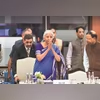 "Festival cheer: Two-rate GST structure approved; new rates from Sep 22")


 Connect with us on WhatsApp