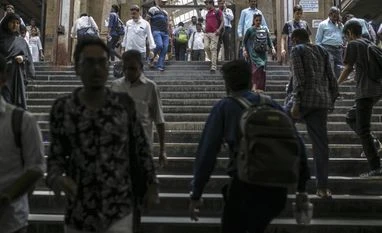
India’s urban unemployment rate fell for the second consecutive quarter in Q1FY24 (April-June 2023) to 6.6 per cent, down from 6.8 per cent in the previous January-March quarter of 2022-23, reflecting a sustained improvement in labour markets.
The Periodic Labour Force Survey (PLFS) results, released by the National Statistical Office (NSO) on Monday, show that the unemployment rate in current weekly status (CWS) terms for those above 15 years of age in the June quarter was the lowest recorded in five years, since the NSO began releasing India’s quarterly urban jobless rate in December 2018.
The jobless rate in urban areas has been steadily declining since the high of 12.6 per cent recorded in the Covid-affected April-June quarter of FY22.
The unemployment rate among men and women was estimated at 5.9 per cent and 9.1 per cent, respectively, down from 6 per cent and 9.2 per cent in the previous quarter. These figures have also been declining since the April-June quarter of FY22, when they were estimated at 12.2 per cent and 14.3 per cent, respectively.
Suchita Dutta, executive director of the Indian Staffing Federation (ISF), said that amid demand growth across industries, projected growth in consumerism, and ahead of festival season, employment witnessed a positive trend in Q1FY24. “The sectors driving the change in urban employment have been primarily the retail, logistics, and e-commerce sectors, along with hospitality and banking, financial services & insurance. As these sectors continue to flourish hand-in-hand with technological advancements and shifting market dynamics, they offer a promising outlook for both immediate and long-term employment prospects as well,” she said.
However, the unemployment rate for youth (15-29 age group) reversed its downward trend and increased to 17.6 per cent in the June quarter, from 17.3 per cent in the previous quarter. People belonging to this age group are usually first-timers in the labour markets and this metric reflects its robustness.
The latest quarterly survey also showed that the labour force participation rate (LFPR), which represents the percentage of people either working or seeking work in the urban population, saw a marginal increase to 48.8 per cent in Q1FY24, from 48.5 per cent in Q4FY23. Women showed greater enthusiasm for work as their LFPR increased by 0.5 percentage points to 23.2 per cent sequentially. The LFPR for males remained unchanged at 73.5 per cent.
But this increased enthusiasm for work did not translate into better jobs for women, as the share of salaried jobs continued to fall among women for the fifth consecutive quarter. The share of salaried work for women stood at 54 per cent in the June quarter, down from 54.2 per cent in the March quarter. Increasingly, women found work in the self-employed category (39.2 per cent in Q1FY24 against 38.5 per cent in Q4 FY23), which includes working as unpaid helpers in household enterprises or owning an enterprise.
The share of men in regular salaried jobs increased to 47.8 per cent, up from 47.3 per cent during the period under review.
Given the importance of having labour force data available at frequent intervals, the NSO launched India’s first computer-based survey to measure labour force participation dynamics at three-month intervals for urban areas in April 2017.
Before the PLFS, the National Sample Survey Organisation (now known as NSO) under the Ministry of Statistics and Programme Implementation used to bring the data related to employment and unemployment based on household socioeconomic surveys once in five years.

 "Urban jobless rate falls for second consecutive quarter to 6.6 % in Q1")


