With Bihar witnessing 1.4 million first-time voters, and political parties betting on the youth wave this election season, one link remains missing- student leaders.
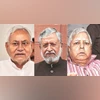
Once a breeding ground for political stalwarts, like Nitish Kumar, Sushil Kumar Modi, and Lalu Prasad Yadav, Bihar’s student politics, now, is in a state of apathy, with student union members and ground workers attributing this downfall to irregular polls, student migration, funding crunch, and lack of opportunity, among other reasons.
“Student leaders here are largely being used for the crowd-filling exercise,” says Shashi Kumar, Bihar general secretary of Congress' student wing, National Students' Union of India (NSUI).
“For 4.5 years, we are asked to be leaders, run outreach programmes, give speeches, and connect with the youth. Just before the tickets are being sent out, we are called party workers whose loyalty will now be tested,” he says, adding that this is a trend across unions.
Bihar Assembly elections are scheduled in two phases- November 6 and 11.
Student leaders from outside state
Even as parties are betting on student leaders, many of them are the ones who migrated for education and returned to the state after being seen as a cutout for politics.
Consider Dhananjay, a 29-year-old from Gaya, who was elected as the Jawaharlal Nehru University Students Union (JNUSU) president in 2024. He is now contesting the Bihar Assembly election from Bhorey constituency on a Communist Party of India (Marxist–Leninist) Liberation ticket.
“Unlike JNU, Delhi University (DU) or maybe the Banaras Hindu University (BHU), institutes in Bihar have failed to maintain a healthy political environment,” says N Sai Balaji, JNUSU president for 2018-19, adding that student migration is a significant factor.
Struggling with migration, funding crunch and lack of recognition, Bihar’s student wings are now trying for representation at the national level.
DUSU’s current Joint Secretary Deepika Jha and former JNUSU president Kanhaiya Kumar are among many other student leaders from Bihar who started their political journey from outside the state.
Deteriorating standard of education has largely contributed to this migration.
According to a report by India Data Map, Bihar’s school dropout rate at secondary and higher secondary levels remains concerning at 19.5 per cent and 10.3 per cent, respectively.
“Without good academicians and healthy democratic exposure, you will not be able to retain the talent pool, the potential leaders,” Balaji adds.
In this election, there are many emerging faces who have received education from different parts of the world.
The Plurals Party’s founder Pushpam Priya Choudhary, who is contesting from Darbhanga, and Rashtriya Janata Dal’s Shivani Shukla, who is in the fray from Lalganj, have completed their higher education from the UK, while Dipu Singh, fighting from Sandesh seat, is a 2017 DU graduate. Bihar’s youngest MP Shambhavi Choudhary is also a DU graduate.
Local party workers in Bihar are of the view that while gaining education from outside the state is not a problem, stereotyping against the local leaders is unfair. “They can have a better mass influence among the youth, but the student leaders (from here) understand the root issues of specific constituencies,” says NSUI’s Kumar. “We are often told that if you are confident about your reach, go independent,” he adds.
In the time of growing social media influence, a well-managed PR also plays a key role, notes Yagyawalkya Shukla, former national general secretary, ABVP.
“Local leaders are there, but exposure is a problem,” he says. The youth in the state, however, still looks forward to somebody who has risen from one of them.
“I am associated with ABVP, completely opposite from an ideology that Dhananjay follows, but as somebody who has come from there, I keep looking at his campaigns,” he adds.
According to the student leaders who have been associated with the Assembly elections, the transition from student leader to being a national contender requires nurturing.
“Student elections are fought on more realistic issues like security and infrastructure. Assembly elections, especially in Bihar, are a battle of ideologies and caste,” adds Shukla.
To put this in context, it was only in March 2025 that Patna University Student Union scripted history by electing its first female president. Moreover, in a first, three top positions were bagged by women candidates. However, in the Assembly elections, merely 9 per cent of the candidates are women.
According to Divyanshu Bhardwaj, a former PUSU president and now a Janata Dal (United) candidate from Motihari, failure of universities and unions to conduct timely elections has hampered the political culture.
“The PUSU elections were not conducted for years. How many unions have protested?” questions Bhardwaj. “Now it seems like the unions do not want to create more leaders. Nobody here wants new faces emerging as threats,” he adds.
Bihar student elections, first held in 1959 from Patna University, did not take place after 1984. It was only in 2012 that the practice was revived, but it has been irregular since then. However, it was the 70s that changed the course for the state’s politics. Student-led protests under Jayaprakash Narayan took the country by storm. Started as a student movement against misrule and corruption, the Sampoorna Kranti movement laid the ground for the first non-Congress government in the country in 1977. In the process emerged the biggest leaders of Bihar, including Lalu Prasad Yadav, Nitish Kumar, Sushil Kumar Modi, and several others, including former Union minister Ravi Shankar Prasad, giving wings to the political aspirations of students from across the state.

 "Can Bihar's student politics reclaim its lost legacy in 2025 polls?")










 Connect with us on WhatsApp