The recently released song 'Ramji aake bhala karenge', from the forthcoming Hindi film ‘Bhoot Bangla’, directed by Priyadarshan, pays homage to Satyajit Ray’s classic fantasy-musical, ‘Goopy Gyne Bagha Byne’ (1969), as
several online cinephiles noted. Starring the film’s leading man, Akshay Kumar, the song has been written by Kumaar and Mellow D, with music by Pritam. In the song, Akshay’s character is seen frolicking with several ghosts, whom he describes through a rap-like listicle: narr bhoot, maada bhoot, seedha bhoot, sada bhoot (male ghost, female ghost, straight ghost, simple ghost…) and so on. The lyrics evidently bear a striking resemblance to the older film’s Bengali song, ‘Bhooter raja dilo bor…’ (The king of ghosts gave us boons…), written and composed by Ray.
There has been some online chatter about plagiarism and Bollywood does not have a great reputation for respecting originality; Pritam, too, has previously
faced accusation of lifting tunes without acknowledgement. However, it might be safe to give the makers of ‘Bhoot Bangla’ the benefit of doubt that they were paying tribute to Ray, arguably India’s most famous post-Independence film director. In recent years, several Indian and international films have paid tribute to Ray. The 2007 film ‘The Darjeeling Limited’, directed by Wes Anderson, used Ray’s music extensively as its background score (and had a picture of Ray on the walls of the train where the action takes place).
Anderson also used the memory game from Ray’s ‘Aranyer Din Ratri’ (1970) in his 2025 film ‘Asteroid City’. Similarly, the scene in ‘Man of Steel’ (2013), directed by Zack Snyder, where Superman drowns in a pit of skulls is inspired by a similar scene in Ray’s 1966 film ‘Nayak’, where the film’s protagonist, a famous film star, drowns in a pit of money. The 2022 Bengali film ‘Aparajito’, directed by Anik Dutta, is a biography of Ray, depicting the making of his debut, the cult classic ‘Pather Panchali’ (1955). However, while Anderson’s use of Ray’s music or scene in his films add layers of aesthetic complexity to them, it remains to be seen what purpose the choices of Pritam and Priyadarshan serves. In any case, it prompted me to rewatch ‘Goopy Gyne Bagha Byne’.
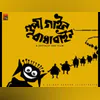
The film was adapted from the eponymous story by his grandfather, the reputed writer and painter Upendrakishore Ray Chowdhury. It opens with Goopy (Tapen Chatterjee), the simpleminded son of the village grocer, returning to his village with a tanpura, determined to become a singer. However, when the village elders realise that Goopy has a rather unpleasant voice, they play a joke on him. They advise him to go to the palace of the local king and demonstrate his musical talent. When Goopy follows their advice the next day, the king ridicules him, breaks his musical instrument and exiles him from the village. In the forest on the outskirts of the village, Goopy meets a drummer, Bagha (Rabi Ghosh), who has also been exiled from his village.
As night descends on the forest, the ghosts who live there emerge and engage in the iconic dance sequence of the film. The king of ghosts give Goopy and Bagha three boons — they can eat and wear whatever they like by clapping each other’s hands; they can go wherever they like by wearing magical shoes and clapping hands; and whenever they would perform any song, everyone listening to them would be mesmerised by their music. The next day, Goopy and Bagha teleport themselves to the land of Shundi (Santosh Dutta), where the king is holding a competition to appoint the next court musician, which Goopy and Bagha win quite easily. However, Shundi is a land beset with troubles: Its neighbour, Halla, ruled by the twin brother (also played by Santosh Dutta) of the Shundi king, is threatening to invade it.
Goopy and Bagha convince the king of Shundi to let them go to Halla and try to stop the impending war. They find that the king is manipulated by an evil minister (Jahor Roy) and his ally, a wizard called Borfi (Harindranath Chattopadhyay). Despite all their efforts, Goopy and Bagha are unable to prevent Halla’s army from marching towards Shundi. In a last-ditch effort, the two friends confront the army with a poignant anti-war song: “Oh the soldiers of Halla King, / What’ll you gain by fighting?” The song ends with Goopy and Bagha using their magical powers to summon hundreds of pots of sweets that descend from the skies like manna. The underfed soldiers of Halla abandon their posts, running around to catch a pot of sweet, and the war plans of the evil minister are foiled.
In Ray’s biography ‘The Inner Eye’, Andrew Robinson cites several reasons why the filmmaker took up this project: a childhood love for fantasy, his son Sandip’s entreaties to make a film for children, the desire to work with music, to shoot in Rajasthan’s stark and beautiful desert landscape, and finally an eye on the box office. The film fulfilled all these objectives, including a healthy theatrical run of 51 weeks — a record for a Bengali film till then. It also won Ray the Best Film and Best Direction awards at the 16th National Film Awards in 1970. While a lot of writing on the film has focussed on its
adaptation strategies and use of fantasy, its music and its
depiction of social relations, what has received far less attention is its anti-war message, which would have had a contemporary resonance and seems quite pressing even now.
The construction of the Berlin Wall in 1961 demonstarted the stark polarisation of the world, and the Cuban Missile Crisis of 1962 brought it to the brink of nuclear catastrophe. The escalation of the Vietnam War from 1963 onwards, which Ray referenced in his 1970 film ‘Pratidwandi’, kept it on the edge.
India, too, fought two major wars in the 1960s. The 1962 border conflict with China exposed India’s unpreparedness to face aggression from its neighbour, and the 1965 conflict with Pakistan worsened relations between both nations. It is undeniable that ‘Goopy Gyne Bagha Byne’, released at the end of the decade, was a response to the many different conflicts roiling the world. Unfortunately, as I watched it on Saturday morning, my newsfeed was overwhelmed with minute-by-minute updates of the US and Israel attack on Iran, the latest conflict in a series of wars (Ukraine, India-Pakistan, the genocide in Gaza, Sudan) that have roiled our world.
The apparent solution to conflicts that Ray provides might seem quite naïve to many of us. Two singers, no matter how magical their music, are evidently ineffectual against hypersonic and ballistic missiles. But I would argue that Ray is not suggesting art as a solution to conflicts; instead, he is offering community as essential to the process of making art and engendering peace. Goopy and Bagha can perform their music, magically summon food and clothes, and teleport themselves only when they are together. In an early scene in the film, soon after they have received the boon from the king of ghosts, Goopy asks Bagha about his plans. Bagha says he wants to travel around and see the world. Goopy laughs and says: “Then, I will also have to travel with you. You can’t clap with one hand, can you?” I believe this is key to the process of artmaking, and also the antidote to ending all conflict. The magic happens when we sing together, and not in isolation. ____________________________________________________
(Uttaran Das Gupta is an independent writer and journalist)

 "Satyajit Ray's 'Goopy Gyne Bagha Byne': Singing in the dark times")



