US reciprocal tariffs: India-China ties see signs of thaw amid uneasy times

While border issues remain, Trump's tariff war seen as influencing the neighbours' relationship
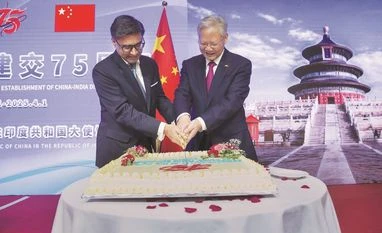
Vikram Misri, Xu Feihong
Foreign Secretary Vikram Misri (left) and Chinese Ambassador to India Xu Feihong commemorating the 75th anniversary of India-China diplomatic relations on April 1 Photo: Xu Feihong/ X
Satarupa Bhattacharjya New Delhi
4 min read Last Updated : Apr 03 2025 | 11:34 PM IST
India-China ties appear to be mending amid recent signs of the easing of tensions. The US trade war in which the two Asian giants are caught is also a factor.
 
The 75th anniversary of the establishment of diplomatic relations was marked on April 1 by an exchange of greetings between President Droupadi Murmu and Chinese President Xi Jinping. India was among the earliest countries to recognise the People’s Republic of China.
 
Prime Minister Narendra Modi and Xi met on the sidelines of the Brics summit in Kazan, Russia, in October. It was the two leaders’ first major meeting since the fatal confrontation in the Galwan River valley five years ago. At least 24 Indian and Chinese soldiers were killed. Multiple rounds of military and diplomatic talks have since been held.
 
On an American podcast in March, Modi said India and China were working to restore conditions to how they were before 2020. In his message to Murmu, Xi said the development of China-India relations was the right choice.
 
On Tuesday, the Chinese embassy hosted a commemorative event, with cake-cutting and speeches by Foreign Secretary Vikram Misri and the Chinese Ambassador to India Xu Feihong in New Delhi. Both sides expressed a willingness to work things out. Misri said the 75th anniversary has provided an opportunity to rebuild bilateral ties.
 
The Chinese side anticipates Modi will visit Tianjin, China, for the multi-country Shanghai Cooperation Organisation summit this autumn.
 
India and China have agreed, in principle, to restart direct flights that were suspended in 2020 during China’s “zero-Covid” policy and in the aftermath of the border clash that June. The two sides have also talked about sharing data on river water.
 
The civil aviation ministries of both countries are working on an air-services agreement, an Indian official said. The resumption of direct flights might take time, another official said.
 
China has given 70,000 visas to Indians so far this year, according to the Chinese embassy. But no notification on Indian travellers to Kailash is out. The two countries have discussed reopening the pilgrimage for Indians this summer. China allows tourists to circumambulate the holy site in Tibet on vehicles.
 
The issue of journalist visas is unresolved. The Chinese government, which said it was taking “counter measures” while not issuing visas to most Indian media in 2023, has since expressed interest in the reciprocal issuance of visas. The Indian government, which once issued a “disproportionate” number of visas to Chinese media, has not expressed new interest beyond a recent statement on people ties.
 
Foreign policy analysts say while mistrust still lurks at the border, the “US factor” is likely influencing India-China relations.
 
Shyam Saran, India’s former foreign secretary, said media statements from the People’s Liberation Army and China’s Foreign Minister Wang Yi have shown “Beijing’s positive attitude” but “substantive change, as far as the border is concerned,” remains to be seen — unlike in the past, the troops haven’t gone back to their bases.  
 
The Galwan clash was the most serious China-India conflict after the 1962 war.
 
Srikanth Kondapalli, professor of China studies at Jawaharlal Nehru University, said the troops have disengaged, but “they have gone back only short distances” from the Line of Actual Control, and much of the gathered military equipment have not been removed. The “de-escalation” is pending. “On the strategic level, uncertainty prevails,” Kondapalli said.
 
India and China have started joint patrolling in some areas along the border, an official said.  
 
On Wednesday, US President Donald Trump announced tariffs on imported goods from more than 100 countries and regions, including China (34 per cent on top of an earlier 20 per cent) and India (27 per cent).
 
“We don’t know what will happen in the future but it might be a good idea for China and India to work together in these uncertain times, if favourable to both,” Saran said.
 
The Trump tariffs are weighing on this relationship, Kondapalli said.
 
China is India’s largest trading partner ahead of the United States. India-China trade was $118.4 billion in 2023-34, of which, India’s deficit was $85 billion.

One subscription. Two world-class reads.

Already subscribed? Log in

Subscribe to read the full story →
*Subscribe to Business Standard digital and get complimentary access to The New York Times

Smart Quarterly

₹900

3 Months

₹300/Month

SAVE 25%

Smart Essential

₹2,700

1 Year

₹225/Month

SAVE 46%
*Complimentary New York Times access for the 2nd year will be given after 12 months

Super Saver

₹3,900

2 Years

₹162/Month

Subscribe

Renews automatically, cancel anytime

Here’s what’s included in our digital subscription plans

Exclusive premium stories online

  • Over 30 premium stories daily, handpicked by our editors

Complimentary Access to The New York Times

  • News, Games, Cooking, Audio, Wirecutter & The Athletic

Business Standard Epaper

  • Digital replica of our daily newspaper — with options to read, save, and share

Curated Newsletters

  • Insights on markets, finance, politics, tech, and more delivered to your inbox

Market Analysis & Investment Insights

  • In-depth market analysis & insights with access to The Smart Investor

Archives

  • Repository of articles and publications dating back to 1997

Ad-free Reading

  • Uninterrupted reading experience with no advertisements

Seamless Access Across All Devices

  • Access Business Standard across devices — mobile, tablet, or PC, via web or app

Topics :US tariffsTrump tariffsUS trade warIndia China relations

Next Story



