India must focus on manufacturing to compete with China: Jaishankar
Jaishankar maintained that there is no doubt that India is rising, and now it is up to 'us to see how we connect ourselves with the world and use opportunities and challenges thrown by it'
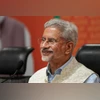
External Affairs Minister S. Jaishankar(Photo: PTI)
To compete with China on the economic front, India should focus on manufacturing, a key sector which was ignored by governments before Prime Minister Narendra Modi came to power in 2014, External Affairs Minister S Jaishankar said on Monday.
He noted that tension at the border with China has caused "abnormality" in New Delhi-Beijing relations, and added India's thinking is absolutely clear that unless there is peace and stability in the border areas, the ties between the two Asian powers will not improve. "If we have to compete with China, which we should, then its solution is that we should focus on manufacturing here. Our approach towards manufacturing has changed after Modiji came to power.
Before that, people did not give much emphasis on manufacturing," Jaishankar said during his interaction with industry leaders at a programme in Surat. There is no other way to counter China on the economic front, insisted the career diplomat-turned-politician while replying to questions from audience members on how he saw India's relationship with the world's second largest economy as it moves towards becoming a USD 5 trillion economy. Jaishankar was speaking at a corporate summit on "Bharat's Economic Rising," organised by the Southern Gujarat Chamber of Commerce and Industry (SGCCI).
"If we talk of rising Bharat, it will rise through technology. You cannot build strong technology on weak manufacturing. At any cost, we should put special emphasis on manufacturing, because that is the only economic response," the Union minister maintained. Jaishankar, a former Ambassador to China, emphasised that tension at the border has affected Sino-Indian ties.
"As you know, there is tension at the border (with China). And this has caused abnormality in our relations. For that our thinking is very clear that unless there is peace and stability at the border, the relations will remain in the same deteriorated condition," he noted. Asked about relationship with Pakistan which remains strained and New Delhi's fight against
terrorism sponsored from across the border, Jaishankar asserted India should never compromise on terrorism. "For us to tolerate, justify (terrorism) -- are all wrong. The only response to terrorism is counter-terrorism. And they should understand this to make it a deterrent," he further said.
Asked about the future of the World Trade Organisation amid China dumping goods in India through dubious methods and advanced countries using the WTO to their own convenience, the minister said while it has its own set of challenges, New Delhi should never leave the global forum. "It (WTO) is a formal and accepted forum for talks.
Here we would put forward our point, work with allies to save our interest. We recently held a meeting on fishing. We should also explore arrangements at bilateral and group levels," he noted. In his speech at the corporate summit, Jaishankar emphasised that reforms carried out by the government and policies framed to counter COVID-19 have helped India emerge from the pandemic and strengthen its economic position to such an extent that today "we are the fastest growing large economy".
"This is one reason why global perception about India has changed," he said. Given India's leadership role, vision, stability, confidence and foreign investment figures, the world wants to collaborate with "us in our journey", said the External Affairs Minister. "This is a very auspicious occasion for us to engage with the world in different ways in different spheres. This is the India of Chandrayaan and UPI, 5G stack and Covaxin which is respected by the world, and where the Modi government will ensure the safety of its people in any corner of the world. We have done this during the COVID-19 pandemic, in Ukraine, Sudan, and Israel," he noted.
Jaishankar maintained that there is no doubt that India is rising, and now it is up to "us to see how we connect ourselves with the world and use opportunities and challenges thrown by it". "I want to assure you that world' idea about India has changed a lot," the former IFS officer added. In the last 10 years, the United Arab Emirates (UAE)'s thinking about India has changed.
The UAE has entered into a free trade agreement with India and trade volume between the two countries has now reached the USD 80 billion-mark, Jaishankar pointed out. The scenario changed after PM Modi's UAE visit in 2015, which was the first trip to the Gulf country by an Indian Prime Minister after Indira Gandhi went there in 1981, he said.
When the USA thinks of technology, it establishes a connection with India, he said and cited a roundtable on the issue organised at the White House during Modi's visit to buttress his point.
An agreement for an economic corridor between India and Europe through Saudi Arabia and the UAE reached during G-20 meet last year and collaboration with the western world on emerging technologies such as semiconductors and drones have put the country in a unique position, he said.
These countries think "that India is a unique, non-replaceable partner and (hence they) want to work with India at any cost," Jaishankar added. "Many countries want to enter into an FTA with India.
Many of our negotiations are underway, but we believe we will only enter into such FTAs when benefits for us are clear and we are not hurt by opening doors for dumping," the minister said. Indian doctors and engineers are in great demand across the world, and the country wants to protect the interest of its people going abroad and ensure they are given equal treatment, he said. "For this, we enter into a mobility agreement with different countries.
In the last two years, we have entered into mobility agreements with Germany, Austria, Italy, France, and Australia. For us opportunities exist even outside the country, and they can come in different forms," Jaishankar added.
(Only the headline and picture of this report may have been reworked by the Business Standard staff; the rest of the content is auto-generated from a syndicated feed.)

 "India must focus on manufacturing to compete with China: Jaishankar")

