A large number of citizens, defence experts and aviation enthusiasts took to social media on Monday (May 26) to demand faster progress on the Kaveri jet engine project. The hashtag #FundKaveriEngine became the number one trend on X with users encouraging Prime Minister Narendra Modi to provide more funding and make the indigenous engine, which has been delayed for so long, a priority.
What is the Kaveri engine and why was it being developed for the Tejas?
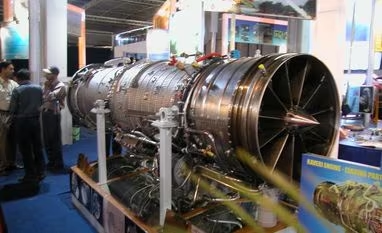
Kaveri is a jet propulsion engine, which the Gas Turbine Research Establishment (GTRE), lab of the
Defence Research and Development Organisation (DRDO), is developing. Kaveri is a low bypass, twin spool turbofan engine with 80 kilonewtons (kN) thrust.
Originally conceived in the 1980s, the Kaveri was intended to power India’s homegrown Light Combat Aircraft (LCA) Tejas. The engine features a flat-rated design to minimise thrust loss under high-speed and high-temperature conditions, and incorporates a twin-lane Full Authority Digital Engine Control (FADEC) system with a manual override for enhanced reliability.
Despite its strategic intent, the engine was delinked from the Tejas programme in 2008 after it failed to meet performance thresholds.
Why has the Kaveri engine been delayed for so many years?
The Kaveri project’s troubled journey can be traced to a combination of technical complexity, geopolitical setbacks, and infrastructure gaps. Key challenges include:
Aerothermal and metallurgical hurdles that India had no prior experience in addressing.
Lack of critical materials, such as single-crystal turbine blades, due to sanctions imposed after India’s 1998 nuclear tests.
Inadequate domestic facilities, forcing India to depend on Russia’s CIAM for high-altitude testing.
Shortage of skilled manpower for such advanced aerospace engineering efforts.
The collapse of a proposed partnership with French firm Snecma by 2013, which was expected to transfer key engine core technologies.
These bottlenecks left the engine underpowered and overweight, especially for the Tejas platform, which ultimately opted for the more powerful GE F404 and later GE F414 engines.
How is the Kaveri engine being repurposed for UCAVs and future platforms?
Although its application in Tejas fighter jets has been shelved, the Kaveri engine began to be reimagined for newer defence platforms. A derivative of the engine is currently under development for powering Unmanned Combat Aerial Vehicles (UCAVs), including the upcoming Ghatak stealth UCAV.
Notably, private sector participation has begun to play a role. Firms like Godrej Aerospace have delivered crucial engine modules, and recent in-flight testing suggests the project has picked up momentum after years of inertia.
What role is the Indian Navy playing in the Kaveri engine programme?
After being delinked from the Tejas programme, the Indian Navy emerged as a key stakeholder in the Kaveri project’s next phase. The Kaveri Marine Gas Turbine (KMGT), a maritime variant of the original jet engine, is being developed to power smaller warships. GTRE has modified the original engine by adding a shaft mechanism, which allows it to drive marine propellers.
The KMGT has undergone extensive testing at the Naval Dockyard in Visakhapatnam, delivering 12 Megawatts (16,000 horsepower) of propulsion power—sufficient to provide “boost power” for smaller naval vessels during combat manoeuvres.
In contrast, larger ships like the Shivalik-class frigates use General Electric’s LM2500 gas turbines, which offer nearly double the boost at 22 MW.
However, the engine has passed performance tests, meeting Navy specifications, but still remains in the development and validation stage before large-scale production and deployment can commence.
How much has India spent on the Kaveri engine and what are the gains?
The DRDO had spent nearly ₹3,000 crore on the Kaveri engine programme by 2016, the last estimate that was provided of the project by late Defence Minister Manohar Parrikar in the Lok Sabha in August of that year. While critics highlight the cost overruns and delays, defence analysts argue that the technological know-how and R&D infrastructure developed through the project will pay long-term dividends, especially in aerospace materials, turbine dynamics, and indigenous testing capabilities.
With its future in UCAVs and naval applications, and a growing chorus pushing for accelerated development, the Kaveri engine project appears to be entering a new phase of relevance.

 "Kaveri engine is trending - here's why it matters for India's defence")


 Connect with us on WhatsApp