Prime Minister (PM) Narendra Modi on Monday urged Brics to work together to make supply chains for critical minerals and technology secure and reliable.
During the Brics summit in Rio de Janeiro, in his intervention at the session “Strengthening multilateralism, economic-financial matters, and artificial intelligence”, the PM said: “It’s important to ensure that no country uses these resources for its own selfish gain or as a weapon against others.”
China, which controls a significant share of the world’s supply of critical minerals, especially rare-earth elements, is a founder, along with India, Russia and Brazil, of the 11-member Brics grouping, whose 17th summit concluded on Monday evening.
With Chinese President Xi Jinping skipping the summit, the country’s premier, Li Qiang, attended it.
A key objective of the PM’s current foreign tour, his longest in a decade, is to look at increasing cooperation in imports and processing critical minerals, including rare-earth elements, in four of the five countries he has visited or is scheduled to visit – Ghana, Namibia, Argentina, and Brazil.
ALSO READ: PM Modi, Malaysia PM discuss Asean-India FTA review at Brics summit India’s search for critical minerals comes in the context of China’s coercive tactics, including restricting supply and price manipulation, in the sector.
In his intervention, the PM welcomed the summit’s emphasis on reforms in the international financial system. He said the Brics New Development Bank (NDB) had offered a strong and credible alternative to support the development aspirations of countries in the Global South. While approving projects, the NDB must focus on demand-driven approaches, long-term financial sustainability, and healthy credit rating, Modi said.
“Strengthening our internal systems will further enhance the credibility of our call for reformed multilateralism,” he said.
The PM also flagged concerns about risks, ethics and bias in artificial intelligence (AI), and appealed member countries to work together for “responsible AI”, for which “global standards must be created that can verify the authenticity of digital content, so that we can identify the source of the content and maintain transparency and prevent misuse”.
A day after the Brics declaration voiced “serious concerns about the rise of unilateral tariff and non-tariff measures which distort trade and are inconsistent with World Trade Organisation (WTO) rules”, American President Donald Trump said he would put an additional 10 per cent tariff on any country aligning itself with “the anti-American policies of Brics”.
“There will be no exceptions to this policy,” Trump said in a Truth Social post.
The Brics declaration had not named the United States. Trump’s post didn’t specify which policies he considered “anti-American”, nor did it provide details on when any of the tariffs might be imposed.
However, Chinese foreign ministry Spokesperson Mao Ning reacted guardedly to Trump’s threat. The spokesperson told a media briefing in Beijing that Brics was not a bloc for confrontation and did not target any third country.
In Moscow, asked about Trump’s remarks, Kremlin Spokesman Dmitry Peskov said cooperation among Brics members had never been and would never be directed against third countries.

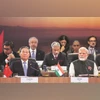 "No country should use critical minerals as a weapon: PM Modi at Brics")


 Connect with us on WhatsApp