Infosys on Thursday said none of its employees had been apprehended by authorities in the United States, after a social media post claimed an employee had been arrested and deported by US Immigration and Customs Enforcement.
The company said one employee had been denied entry at the port of entry and sent back to India, but was not detained or arrested.
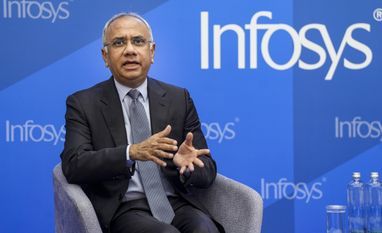
“No Infosys employee has been apprehended by any US authority. A few months ago, one of our employees was denied entry into the US and was sent back to India,” said Infosys CEO Salil Parekh during the company’s third-quarter earnings press briefing on Wednesday.
The clarification came after a post circulated online claiming an Infosys employee from Mysuru, Karnataka, had been arrested at his home in the US and deported.
What the social media post claimed
The post, dated January 13, said the employee had been working on an on-site project in the US and was allegedly given a choice between jail and returning to India.
“Once that chap chose to return back to India, was escorted by agents and handed to airport authorities in the US to ensure he is aboard the flight to India via Frankfurt transit,” the post said.
Infosys denied this account, saying no employee had been taken into custody.
Earlier US investigation into visa usage
The incident surfaced against the backdrop of an ongoing investigation announced by Infosys in October 2025. The company had disclosed that the US Department of Justice was examining how certain H-1B visa holders were classified while working for one of its clients.
“The U.S. Department of Justice (“DOJ”) is conducting an investigation regarding how the Company classified certain H-1B visa-recipient employees working for one of its clients in immigration documents filed with certain U.S. government authorities,” Infosys said in its regulatory filings for the quarter ended September 30, 2025.
“The Company is engaged in discussions with the DOJ regarding its ongoing investigation and has commenced its own inquiry regarding the matter. At this stage, the Company is unable to predict the outcome of this matter, including whether such outcome could have a material adverse effect on the Company’s business and results of operations,” the filing added.
Speaking at the time, Parekh said most of Infosys’ US workforce did not depend on company-sponsored visas. “The majority of our employees in the US are employees who do not require any Infosys immigration support,” he said.
‘No change in approach’ to H-1B visas
During the latest earnings briefing, Parekh said the company’s position on H-1B visas remained unchanged.
“On H-1B and recruiting, our approach is very clear, and as we have shared in the past, our employees in the US—who are not requiring any visa situation—we are continuing with our deployment and delivery using a mix of work in the US and work in India. So, there are no changes to that approach,” he said.
On filing new petitions, he added, “At present, we are continuing with our process since we have our existing set and we will examine it when it comes up in the future.”
H-1B visa process tightened under Trump
The current US administration has tightened controls across three stages: petition processing, evaluation, and physical entry into the United States. Approval on paper no longer guarantees entry or continued work authorisation.
At the US Citizenship and Immigration Services level, petitions face closer review, including extensions and role changes. Requests for Evidence have increased, often seeking detailed proof of job duties, end-client contracts, work locations, and how roles qualify as specialty occupations.
Wage scrutiny has also intensified, with officers comparing job descriptions against Department of Labor wage levels and questioning whether lower-paid roles match highly specialised work.
Narrower reading of eligibility
Eligibility standards are being applied more strictly. Specialty occupation definitions are being read narrowly, with closer attention on whether a role genuinely requires a specific degree.
Employer control is another focus area, particularly for consulting and staffing firms. Authorities are examining who supervises daily work, conducts performance reviews, and controls assignments, especially where employees are placed at client sites.
Entry into the US no longer routine
Even with an approved petition, admission at the border is not automatic. US Customs and Border Protection officers are carrying out more detailed questioning at ports of entry, including secondary inspections.
Travellers may be asked about job roles, work locations, and client details. Entry can be refused if responses do not align with petition filings or if documents are outdated. Social media activity and past compliance records can also be reviewed.
As part of these measures, the administration has introduced a $100,000 fee on new H-1B petitions, citing concerns over misuse of the programme and the need to protect jobs for US citizens, reflecting its “America First” stance on immigration.

 "Indian employee deported by US? Infosys debunks claims, clarifies case")


 Connect with us on WhatsApp