Air India's Maharaja Collection finds permanent public home at Red Fort

Air India's iconic art collection has found a permanent public home at Delhi's Red Fort, with NGMA opening two new galleries showcasing 80 years of patronage
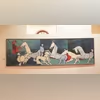
Put together by the airline over eight decades, the collection, which also includes MF Husain's Horses (1977), will be open for viewing from Tuesday (Photo: NGMA)
Put together by the airline over eight decades, the collection, which also includes MF Husain’s Horses (1977), will be open for viewing from Tuesday (Photo: NGMA)
Veenu Sandhu New Delhi
4 min read Last Updated : Dec 21 2025 | 11:38 PM IST
A defining slice of Air India’s cultural legacy has found a permanent public home at New Delhi’s Red Fort, where the National Gallery of Modern Art (NGMA) has opened two new galleries to house the airline’s historic art collection put together over 80-odd years. 
While the galleries were inaugurated on December 5, during a Unesco meeting on safeguarding intangible cultural heritage, they will be thrown open to the public on Tuesday, December 23. But before that, on Monday, when Red Fort is closed to visitors, a special event will be held for the living artists whose works are part of the Air India Maharaja Collection. 
Housed in two restored British-era barracks, called A1 and A2, the galleries bring together artworks that were formally transferred to NGMA in 2023, after Air India officially returned to the Tata group in January 2022. One of the two exhibitions, titled “Wings of Modernity”, presents a sweeping view of Indian art from the mid-20th century onward. 
The selection includes 184 artworks, spanning painting, sculpture, graphic prints, ceramics, and design objects, and reflects the breadth of Air India’s patronage. Major modernists such as VS Gaitonde, MF Husain, SH Raza, KH Ara, B Prabha, NS Bendre, Aparna Caur, and Manu Parekh are represented alongside works by artists including Jeram Patel, GR Santosh, Shanti Dave, SG Vasudev, Anjolie Ela Menon, and Jitish Kallat. 
“Beyond modern and contemporary Indian art, the collection has classical works, textiles, miniatures, and folk art,” says NGMA Director General Sanjeev Kishor Goutam. “The galleries are NGMA’s extension. The aim of housing the collection at Red Fort was to put it in the public domain and make it accessible to a larger audience, given the number of tourists the Unesco World Heritage Site attracts.” The Shah Jahan-era fort is the fourth-most visited destination among domestic tourists and ninth among foreigners. Within Delhi, it is the second-most visited (Qutub Minar being the first).
 
At the “Wings of Modernity” exhibition, the display moves between abstraction and figuration, from Gaitonde’s meditative untitled canvases to Husain’s monumental horses, to B Prabha’s portrayals of rural and working women. Landscapes, mythological references, and explorations of movement recur across the gallery, echoing the themes of travel and transition that defined Air India.
 
Sculpture and three-dimensional works form a significant component of the exhibition. These range from metal and stone figures by artists such as Pilloo Pochkhanawala, PV Janakiram and S Nandagopal to folk and anonymous works in wood and scrap iron.
 
Interspersed through the galleries, where the other exhibition is titled “The End is the New Beginning”, are archival elements linked to the airline’s visual history: Representations of the iconic Maharaja mascot, decorative objects, and models of aircraft, one of them being ‘Shahjehan’, as the Boeing 747 “Jumbo Jet”, which was part of Air India’s ‘Emperor’ fleet was named.
 
“It took about a year to bring the collection from Nariman Point (where Air India’s iconic building was located in Mumbai) to here, and three-four months to put the galleries together,” says Goutam, who is a practising artist with expertise in print-making. The galleries were created at the protected monument without disturbing its core structure, he adds.
 
While the galleries have been described as permanent, NGMA has indicated that portions of the display may be periodically refreshed.
 
The Air India galleries are part of a wider expansion of museum and gallery spaces at Red Fort, which has also introduced new permanent exhibitions – one on arms and armour by National Museum, and another on archaeological finds. As part of the experience, a souvenir shop, too, has been opened in the complex.

One subscription. Two world-class reads.

Already subscribed? Log in

Subscribe to read the full story →
*Subscribe to Business Standard digital and get complimentary access to The New York Times

Smart Quarterly

₹900

3 Months

₹300/Month

SAVE 25%

Smart Essential

₹2,700

1 Year

₹225/Month

SAVE 46%
*Complimentary New York Times access for the 2nd year will be given after 12 months

Super Saver

₹3,900

2 Years

₹162/Month

Subscribe

Renews automatically, cancel anytime

Here’s what’s included in our digital subscription plans

Exclusive premium stories online

  • Over 30 premium stories daily, handpicked by our editors

Complimentary Access to The New York Times

  • News, Games, Cooking, Audio, Wirecutter & The Athletic

Business Standard Epaper

  • Digital replica of our daily newspaper — with options to read, save, and share

Curated Newsletters

  • Insights on markets, finance, politics, tech, and more delivered to your inbox

Market Analysis & Investment Insights

  • In-depth market analysis & insights with access to The Smart Investor

Archives

  • Repository of articles and publications dating back to 1997

Ad-free Reading

  • Uninterrupted reading experience with no advertisements

Seamless Access Across All Devices

  • Access Business Standard across devices — mobile, tablet, or PC, via web or app

Topics :Red FortAir Indiaart collectionArt galleryIndian artists

Next Story


