
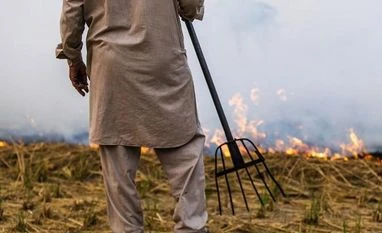
Basmati farmlands in Jammu adopt reaper tech to get rid of stubble menace
Seventy per cent of harvesting has been done. The crops were sown after India and Pakistan agreed on a ceasefire in 2021
 "Basmati farmlands in Jammu adopt reaper tech to get rid of stubble menace")
Explore Business Standard
Seventy per cent of harvesting has been done. The crops were sown after India and Pakistan agreed on a ceasefire in 2021
India's basmati-rich agriculture fields in Jammu and Kashmir's R S Pura border belt have adopted a new technology, wherein modified reapers are used to get rid of the menace of stubble burning.
The department of agriculture (DoA) has introduced modified reapers to cut stubble and convert it into fodder.
"The use of reapers will not only end farm fire and pollution but also create fodder for cattle," Manager, Seed Multiplication Farm Chakrohi, Rakesh Khanjuria told PTI.
Khajuria said that use of new technology not only prevents pollution, farm fires and destruction of minerals in soil and insects, but creates fodder for cattle of the region and employment for the local youth.
Officials said that the introduction of reapers to create fodder instead of pollution should be introduced not only in the entire J&K but also in Punjab and Haryana.
"Delhi, Haryana and Punjab, where such incidents are increasingly taking place, should adopt this (reaper technology of stable chopping). It should be used in the entire J&K. This will control pollution and will give a fillip to mushroom and dairy enterprises," he said.
Farmers and harvesters are working against time to reap 13 varieties of wheat sowed on 850 acres in fertile agriculture land on two sides of border fencing on the International Border in Jammu and Kashmir's Chakrohi that was off limits till a year ago, due to Pakistani shelling.
Seventy per cent of harvesting has been done. The crops were sown after India and Pakistan agreed on a ceasefire in 2021.
The Seed Multiplication Farm, which is spread on nearly 1,000 acres on two sides of the border fencing in the Chakrohi-Jora farm belt about 50 kilometres from Jammu, is said to grow the best seeds of wheat, basmati, oil, fodder and vegetables.
The introduction of the modified reaper has become a source of income generation for the locals and low cost fodder for dairy industry and cattle owners.
"Today, the technology -- reaper, which has been introduced by the department of agriculture, has facilitated people getting fodder at their doorstep at cheap rates. They are using this for starting a dairy enterprise and are getting benefited too and getting good income", Khanjuria said.
Local youth have got jobs by procuring rippers based on modified tractors setup with an attached collection trolley and are earning their livelihood by selling fodder to people at their doorsteps.
Locals used to get fodder at costly rates from distant shops. "It costs them Rs 6,000 to Rs 7,000 per trolley from the shop. But we provide them with trolleys at the cost of Rs 2,000 at their doorstep. Both of us are benefited. We get work here", a reaper owner from Chakrohi village Suneel Kumar said.
(Only the headline and picture of this report may have been reworked by the Business Standard staff; the rest of the content is auto-generated from a syndicated feed.)
First Published: May 16 2023 | 11:25 PM IST


