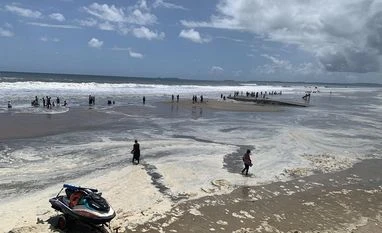
A severe cyclone is raging towards the Gujarat coast. Trains have been cancelled, boats have been firmly anchored and thousands are being evacuated. Cyclone Biparjoy, one of the longest Arabian Sea cyclones to turn its attention to India, promises to be a force to reckon with. Central and state machinery has been activated. And in the thick of the operation to tackle it is the National Disaster Response Force (NDRF), the world’s single-largest such force that stays on its toes 24x7, 365 days a year.
The NDRF’s mandate is clear: Prevent, or minimise, loss to life and property when the enemy is known. Provide rescue and relief at the earliest and to the utmost level possible when calamity, natural or otherwise, strikes unannounced. The force is not confined by state borders. Nor does it wait for outside orders to spring into action.
“The teams must move within the first 20 minutes of the information, in uniform and equipped with whatever gear that might be needed for that specific operation,” says NDRF Director General Atul Karwal, a 1988 batch IPS officer, a black belt in martial arts and a trained scuba and sky diver.
Sitting in his office a kilometre or two from the Old Parliament House in New Delhi, the 59-year-old officer who is a National Security Guard-trained commando and has scaled Mount Everest, says when the Balasore triple-train accident happened on June 2, the first team was mobilised in 10 minutes. “We already had a team stationed at Balasore, but the first call came from an NDRF jawan who was on the Coromandel Express,” says Karwal. “He alerted us after checking himself for injuries, and then immediately started pulling people out because of his training.”
The training is intense and diverse, and requires a certain profile – physical and mental.
NDRF works on 100 per cent deputation. The personnel are drawn from the Central Armed Police Forces, or the paramilitary, such as the Border Security Force (BSF), Central Reserve Police Force (CRPF), Indo-Tibetan Border Police (ITBP), Assam Rifles and others. It has 16 battalions, each 1,149-strong and each with its dog squad, stationed across India. There are also 28 regional response centres (34 more are proposed). The force includes women, who are also involved in operations and undergo the same kind of training as the men. The Turkey earthquake rescue operation in February this year, for instance, had five NDRF women, one of whom had left her twins behind to head for the rescue.
At all times, one NDRF team is on standby, practically with its boots on, and can be dispatched immediately. This team is rotated every seven days.
NDRF also gets quick support from other agencies and forces. For the Turkey operation, for instance, the Indian Air Force (IAF) flew out the first NDRF team the very night the earthquake struck. Its C-17 Globemaster aircraft carried both the rescuers and trucks and buses. “When we landed, we were completely self-sufficient, unlike many other teams that got stuck at the airport in the absence of local transport,” says Karwal.
Sub-Inspector Shivani Agrawal, who is on deputation from ITBP and was involved in the Turkey rescue, says the scale of devastation and harsh winter both hit them hard but the training taught them to quickly get down to the job. “From removing victims, alive or dead, handling equipment, providing emotional support to families and crowd-control, we did it all,” she says. “In times such as these, you have to think on your feet and give it your all. We moved from one rescue site to the other through the aftershocks.”
Karwal says as a memory of this relief and rescue operation, the teams from India and other countries exchanged badges and discs from their uniform.
The deputation to NDRF is for seven years. Those who are young and hardy are preferred, but not freshers because besides physical fitness, the job requires maturity and restraint. “You are dealing with people who might have suffered loss and are probably in grief; some may even be angry,” says Karwal. “So, my person has to be very cool-headed, understanding that he should not retaliate or respond in a rude manner.”
What’s also assessed is the candidate’s “hardship score”: Has that person served in tough postings, say in Kashmir or Chhattisgarh? Higher the score, greater the chances of being inducted. Another ask is that the candidate be better educated, ideally with a science background – “someone who’d be better equipped in the event of, say, a chemical disaster,” says Karwal.
After the initial sifting comes the demanding training, either in their battalions or under specialised agencies, within or outside India, says the commander of an NDRF team. Scuba diving, intense and timed swimming, fire-fighting, rope rescue, animal disaster management, boat maintenance, psycho-social intervention, how to handle the body of a disaster victim, chemical, biological, radiological and nuclear awareness… the list of courses is long.
This is a force that is trained to pull people out of a collapsing building. Or retrieve bodies from a sunken bogie, diving deep with heavy-duty equipment to cut through metal.
A jawan, who was just five days into NDRF when the Odisha train disaster happened, was part of a team that provided first aid and assistance to passengers reeling from the trauma of the accident. The jawans also provided on-the-spot training and guidance to civilian volunteers and first responders with the right methods of lifting, hammering, or chiselling through the debris to rescue those trapped beneath.
Meanwhile, the dog squad is trained to sniff out not drugs or explosives but life. Labradors are preferred since they are more trainable, gentle and hardier compared to, say, German Shepherd, which is not as climate resistant. Now, 50 new pups are being inducted into the force.
NDRF also enjoys strong technology and data support, and is constantly upgrading it. “The Bhaskaracharya Institute for Space Applications and Geoinformatics (BISAG), for instance, provides several layers of data,” says Karwal. “So, the rescuer can be informed in real time about the fastest route to a place that might be inundated? Or, if it’s a chemical disaster, what chemical is it; what are its effects; what is the antidote; and what is the wind speed and direction, depending on which what are the areas that need to be evacuated first….”
All this requires funds. “The force is very well-supported and well-regarded. The (home) ministry is very keen that we modernise and become better trained and equipped,” says Karwal, “So I don’t see a budget constraint. When NDRF needs more money, it’s normally given to it.”
Those posted to NDRF get five or 10 per cent extra as deputation allowance, but no more. “The job is tricky. We do lose rescuers, sometimes during training and at times in operations,” says Karwal. During a Kedarnath floods rescue in 2013, nine NDRF personnel were among the 20 killed when an IAF helicopter crashed.
Karwal wants the force to be fit, mentally and physically. “They see a lot of havoc, misery and trauma,” he says. Counselling has been made available and “we are trying to get a permanent counsellor in our strength,” he says.
The personnel are being encouraged to bring their body mass index (BMI) to the ideal level of 25. “We have digitally mapped everybody's BMI. Till January last year, 33 per cent of my people were above 25 BMI. Now that’s down to 10 per cent.” Not just the jawans, their wives were also counselled on a healthy diet. An interaction with actor Akshay Kumar, a fitness enthusiast, was also organised.
Amarjeet Rathi, a sepoy on deployment from CRPF, says he’s brought his weight down from 98 to 84 kg in two months through high-protein and low-fat diet and exercise. Vikram Singh, a third constable who cut 18 kg in 3.5 months through walking, running and skipping dinner, says, “It was tough but I feel good now.” He used to weigh 100 kg.
Karwal says they are living the NDRF mantra: “Other people’s lives depend on my fitness.”
(with inputs from Debarghya Sanyal)