Datanomics: Recent stampedes highlight need for better crowd management

It is ironic that the latest accident was caused by a stampede triggered by a rush of devotees trying to board special trains meant to facilitate pilgrim travel to the Mahakumbh

Stampede, New Delhi stampede
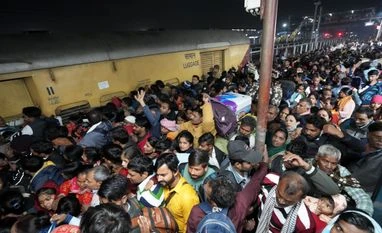
New Delhi: Heavy rush of passengers to catch a train for Mahakumbh, at the New Delhi railway station, Saturday, Feb. 15, 2025. A stampede-like situation occurred at the station, injuring many. (Photo: PTI)
Indivjal Dhasmana New Delhi
2 min read Last Updated : Feb 17 2025 | 11:31 PM IST
Official records show that 48 people died in two incidents of stampede in a span of just one-and-a-half month in the new year. Both the accidents related to Maha Kumbh, though places of their occurrence were different — Prayagraj in Uttar Pradesh, and New Delhi.  
The other two major incidents of stampede in recent years also related to religious congregations — at least 100 people died at a prayer meeting in Hathras in Uttar Pradesh in 2024, and 36 people were killed when a slab on top of a well collapsed during a religious event at a temple in Indore city a year before. 
These accidents clearly highlight the need to manage crowds of devotees during religious gatherings, more so in mega events such as Maha Kumbh. 
Meanwhile, over the years, the Railways has been spending around one-fifth of its total expenditure on safety-related works. The percentage is projected to increase to 21 during the current financial year (FY25) against 19.7 per cent in FY24. It is pegged at 20.6 per cent for FY26. However, such cases are not categorised as Railway accidents even as the ministry has announced compe­nsation to those killed and injured. 
The number of stampede cases has come down from 557 in 2013 to six in 2022, and deaths caused by them from 400 to 22 over the 10-year period. These represented a minuscule percentage of total accidents or even those driven by unnatural causes, such as road accidents, train mishaps, air crashes, drowning, etc. even at its peak in 2013, such accidents accounted for just 0.09 per cent of total accidents caused by unnatural forces. 


One subscription. Two world-class reads.

Already subscribed? Log in

Subscribe to read the full story →
*Subscribe to Business Standard digital and get complimentary access to The New York Times

Smart Quarterly

₹900

3 Months

₹300/Month

SAVE 25%

Smart Essential

₹2,700

1 Year

₹225/Month

SAVE 46%
*Complimentary New York Times access for the 2nd year will be given after 12 months

Super Saver

₹3,900

2 Years

₹162/Month

Subscribe

Renews automatically, cancel anytime

Here’s what’s included in our digital subscription plans

Exclusive premium stories online

  • Over 30 premium stories daily, handpicked by our editors

Complimentary Access to The New York Times

  • News, Games, Cooking, Audio, Wirecutter & The Athletic

Business Standard Epaper

  • Digital replica of our daily newspaper — with options to read, save, and share

Curated Newsletters

  • Insights on markets, finance, politics, tech, and more delivered to your inbox

Market Analysis & Investment Insights

  • In-depth market analysis & insights with access to The Smart Investor

Archives

  • Repository of articles and publications dating back to 1997

Ad-free Reading

  • Uninterrupted reading experience with no advertisements

Seamless Access Across All Devices

  • Access Business Standard across devices — mobile, tablet, or PC, via web or app

Topics :StampedeMaha Kumbh MelaDeath toll

Next Story