Delhi saw a marginal improvement in air quality on Tuesday morning, though pollution levels remained alarming in the capital. The Central Pollution Control Board (CPCB) recorded an average Air Quality Index (AQI) of 377 at 8 am, placing it in the ‘very poor’ category. This was a slight improvement from December 15, when the AQI had reached 427 in the ‘severe’ category around 4 pm.
Earlier on Monday, most monitoring stations in the city had reported ‘severe’ AQI, with some stations hitting the maximum index value of 500. On Tuesday, out of 39 CPCB stations, ten remained in the ‘severe’ range, two reported ‘poor’ AQI, and the remaining 27 recorded ‘very poor’ levels. Anand Vihar station recorded AQI at 406, remaining in the ‘severe’ category.
Major hotspots:
Ashok Vihar – 410
Bawana – 403
DTU – 425
ITO – 402
Jahangirpuri – 426
Mundka – 426
Nehru Nagar – 415
Punjabi Bagh – 405
Sirifort – 402
Vivek Vihar – 411
Wazirpur – 426
The dense smog enveloping the city continues to reduce visibility and cause discomfort for residents.
According to AQI classification, 0–50 is ‘good’, 51–100 ‘satisfactory’, 101–200 ‘moderate’, 201–300 ‘poor’, 301–400 ‘very poor’, and 401–500 ‘severe’.
In response to rising vehicular emissions, the Commission for Air Quality Management (CAQM) held the first meeting of its Expert Committee for Delhi-NCR and adjoining areas on Monday. Chaired by Ashok Jhunjhunwala and co-chaired by Prof Randeep Guleria, the committee discussed segment-wise vehicular emission contributions, health risks, and the readiness of electric vehicle infrastructure.
Actionable recommendations to curb emissions are expected in future sessions.
Meanwhile, with air quality reaching dangerous levels, the Delhi government has issued a circular directing schools to shift to online classes for students up to grade five until further notice. This follows the imposition of stage IV restrictions under the Graded Response Action Plan (Grap) to limit pollution in the city.

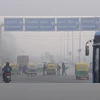 "Delhi air quality shows slight improvement, 10 stations record 'severe' AQI")


