Haku Shah's exhibition in Mumbai spotlights his underloved paintings

The Gandhian artist is best remembered for turning attention to Indian rural and indigenous arts
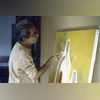
Haku Shah Photo by Parthiv Shah. Courtesy of The Estate of Haku Shah
Haku Shah Photo by Parthiv Shah. Courtesy of The Estate of Haku Shah and Subcontinent
Ranjita Ganesan Mumbai
4 min read Last Updated : Apr 28 2025 | 8:06 PM IST
One of the first things that struck gallerists Dhwani Gudka and Keshav Mahendru when they visited Haku Shah’s home in Ahmedabad was the lack of an easel. The late artist never used one. A studio, even palettes, were conspicuous by their absence. When he felt the urge to paint, Shah would rest the canvas against a wall, and mix colours from tubes of Winsor & Newton — Camel, if he was low on funds — directly on the surface. 
 
Many such stories detail the simplicity of the multi-hyphenate art practitioner, whose paintings remained relatively overlooked throughout his life but have started featuring in recent auctions. While some of his pieces have adorned the home of the illustrious Sarabhai family, the painter just as readily sold works to an IIT professor who could only afford to pay in installments of Rs 500 at a time. If “Hakubhai”, as he was fondly known, met anyone who expressed interest in making art, he would immediately give them a notebook or felt tip pens. 
 
Gudka and Mahendru decided to open Subcontinent, located in South Mumbai’s art district, with a show spanning Shah’s career from the late 1950s until his death in 2019. 
 
“The idea is to look at lesser-known art histories, which are not part of this very linear, clear narrative we’re used to, of the Bengal school, the Progressives, and later the well-known contemporary artists,” Mahendru says. “The narrative is much wider and there’s a lot that happens simultaneously.” 
 
For those studying Indian indigenous arts, the road often led to Hakubhai. It was research on the subject that first took Gudka to Shah and his wife, Viluben, who played an equal role in preserving the artefacts at their home, in 2016. “I didn’t know him as a painter much, but I saw his paintings there and they were quite something.” 
 
The Baroda school painter studied under KG Subramanyan, NS Bendre, and Sankho Chaudhuri.  
 
Shah juggled many assignments to make a living in the arts: Curating exhibitions of rural pottery and toy-making, co-authoring books with art historian Eberhard Fischer, teaching at the National Institute of Design (NID). An active part of the Weavers’ Service Centre, a late-1950s’ initiative that employed artists, he later created a craft village, Shilpgram, in Udaipur and took the Art of Unknown India exhibition to the US. Among other awards, a Nehru Fellowship, a Rockefeller Grant and Padma Shri recognised these contributions.  
 
Curated by Jesal Thacker, the ongoing show, ‘Ya Ghat Bheetar’, glimpses an oeuvre that included sculptures and photographs, but draws special attention to his oils on canvas. Beginning with simple, formalist compositions in the early years, with strongly centred figures, he later embraced a more fluid, expressionistic style. “Painting was like ‘going back’ for him. It was his way of relaxing,” recalls photographer Parthiv Shah, Hakubhai’s son. His father was a Gandhian, and Gandhi’s minimalism informs his work, Parthiv Shah reckons. 
 
Hakubhai’s gaze was unlike that of many artists of his time. Examples such as an untitled piece of a woman head-carrying a pot by a river, and one titled ‘Ya Ghat Bheetar Baag Bageeche’, where a pot contains a human form, have a nearly androgynous appeal. 
 
In subtle ways, his creations bear the influence of his scholarly practice. “There is a conversation between what he’s making as an artist and what he’s doing as an ethnographer,” says Gudka. “But he’s not directly referencing the work of indigenous artists; it is there subliminally. He’s not emulating from their practice; he almost depicts them as subject matter.”
 
A product of the post-Independence years, passionate about making Indian art known around the world but rarely seeking the limelight himself, Shah’s contributions carry many lessons for today.
 
‘Ya Ghat Bheetar, Rediscovering Form’ is on view until May 3 at Subcontinent, Fort, Mumbai
 

One subscription. Two world-class reads.

Already subscribed? Log in

Subscribe to read the full story →
*Subscribe to Business Standard digital and get complimentary access to The New York Times

Smart Quarterly

₹900

3 Months

₹300/Month

SAVE 25%

Smart Essential

₹2,700

1 Year

₹225/Month

SAVE 46%
*Complimentary New York Times access for the 2nd year will be given after 12 months

Super Saver

₹3,900

2 Years

₹162/Month

Subscribe

Renews automatically, cancel anytime

Here’s what’s included in our digital subscription plans

Exclusive premium stories online

  • Over 30 premium stories daily, handpicked by our editors

Complimentary Access to The New York Times

  • News, Games, Cooking, Audio, Wirecutter & The Athletic

Business Standard Epaper

  • Digital replica of our daily newspaper — with options to read, save, and share

Curated Newsletters

  • Insights on markets, finance, politics, tech, and more delivered to your inbox

Market Analysis & Investment Insights

  • In-depth market analysis & insights with access to The Smart Investor

Archives

  • Repository of articles and publications dating back to 1997

Ad-free Reading

  • Uninterrupted reading experience with no advertisements

Seamless Access Across All Devices

  • Access Business Standard across devices — mobile, tablet, or PC, via web or app

Topics :Paintingsexhibitionart exhibition

Next Story


