
India rejects Canada's accusation of violating norms amid diplomatic row
India said it wanted Canada to reduce its number of diplomats in India to match the amount that India has in Canada
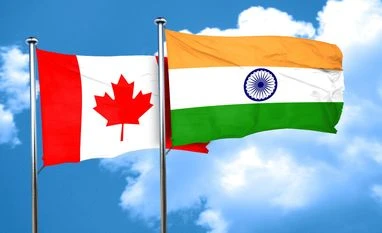 "India rejects Canada's accusation of violating norms amid diplomatic row")
Explore Business Standard
India said it wanted Canada to reduce its number of diplomats in India to match the amount that India has in Canada
The Indian government on Friday rejected any notion that it had violated international law in asking Canada to recall diplomats so that both governments have roughly the same number stationed in each country.
Canada said Thursday it was recalling 41 of its 62 diplomats in India after what it said was New Delhi's warning that it would strip their diplomatic immunity something Canadian officials characterised as a violation of the Geneva Convention.
The back-and-forth comes amid a spat between the two countries over Canada's allegation that India was involved in the assassination of a Sikh separatist in Canada.
India had not publicly stated it would withdraw diplomatic immunity from the Canadian diplomats, nor did it give a deadline for their departure. But it said it wanted Canada to reduce its number of diplomats in India to match the amount that India has in Canada.
We reject any attempt to portray the implementation of parity as a violation of international norms, India's Ministry of Foreign Affairs said in a statement Friday.
Prime Minister Justin Trudeau reiterated Canada's concerns on Friday that India was contravening a fundamental principle of international law and diplomacy," adding that "it is something that all countries in the world should be very worried about."
India said there was a high number of Canadian diplomats in the country. Their continued interference in our internal affairs warrant a parity in mutual diplomatic presence in New Delhi and Ottawa, the statement said.
Canada has alleged India may have been involved in the June killing of Canadian citizen Hardeep Singh Nijjar in suburban Vancouver. India has accused Canada of harbouring separatists and terrorists, but dismissed the allegation of its involvement in the killing as absurd and has taken diplomatic steps to express its anger over the accusation.
Trudeau said last month that there were credible allegations of Indian involvement in the slaying of Nijjar, a 45-year-old Sikh leader who was killed by masked gunmen in June in Surrey, outside Vancouver.
For years, India had said that Nijjar, a Canadian citizen born in India, had links to terrorism, an allegation Nijjar denied.
India also has cancelled visas for Canadians, and Canada has not retaliated for that. India previously expelled a senior Canadian diplomat after Canada expelled a senior Indian diplomat.
(Only the headline and picture of this report may have been reworked by the Business Standard staff; the rest of the content is auto-generated from a syndicated feed.)
First Published: Oct 21 2023 | 6:51 AM IST


