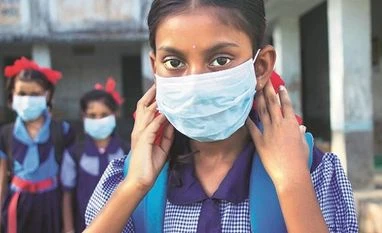
Mask mandates for children are unscientific and rather harmful", says a public health expert, explaining that incorrectly handled masks can make it more risky for disease transmission and their role is limited when Covid is endemic.
Though there are no Covid related guidelines or mask mandates by the government, about 200 private-run schools in the national capital have already made masks compulsory for students and staff members in view of the rising numbers.
"When disease is endemic, the benefit of masks for all age groups and children is even less. Then, we need to remember that an incorrectly handled mask can make it more risky for transmission. If children keep touching the mask, it would make them prone to infection," said Chandrakant Lahariya, general physician and infectious diseases specialist.
"Even during the pandemic stage, WHO did not recommend masks for children younger than five years. For five-12 years of age also, masks were not mandated and were optional. The benefit was negligible and so masks were not mandated," Lahariya told PTI.
According to Sudha Acharya, chairperson of the National Progressive Schools' Conference, about 230 private schools in Delhi have mandated masks and implemented social distancing norms. These include schools such as Bal Bharti, Delhi Public School, St Mary's and Ahlcon Public School.
Masks, Lahariya explained, had a definitive preventive role in the Covid pandemic. When the virus was novel and people unvaccinated, universal masking was helpful in reducing transmission.
"Now, when Covid is endemic and ubiquitous, the role of masks as a public health measure in reducing transmission is limited."
A recent study published in the journal BMJ assessed the effectiveness of mandatory use of face covering masks (FCMs) in schools during the first term of the 2021-2022 academic year in Spain.
The study found no significant differences in SARS-CoV-2 transmission due to FCM mandates.
"Instead, age was the most important factor in explaining the transmission risk for children attending school," the authors of the study concluded.
Lahariya noted that there are studies that carbon dioxide cumulates inside the masks worn for a longer period and those levels may be harmful for children.
"Also, with masks you cannot ask children to play and that means depriving them of physical activity. There are many negative impacts with no benefits."
"Schools are overdoing it by imposing the mask on children, when the government has not made it so.. This is a violation of the rights of children and any school doing so should be protested by parents and penalised by the government," the health expert added.
International guidelines recommend face masks for children aged six years and older, but further studies are needed to provide evidence based recommendations for different age groups.
Lahariya said masks are at best individual protective measures. Making an intervention that provides individual benefit mandatory is not logical, he argued, while adding that high risk people are encouraged to wear masks in specific settings.
"We don't need any specific measure targeted on Covid. In life, to protect against respiratory illness, we need to follow certain preventive measures. These are specific depending upon vulnerability and individual risk," the expert added.
Delhi logged 1,149 fresh COVID-19 cases on Wednesday with a positivity rate of 23.8 per cent, according to data shared by the city government's Health department.
According to D Srikanth, senior consultant paediatrician and neonatologist, Yashoda Hospitals, Hyderabad, children under two years old need not wear a mask as per the WHO as they may not maintain mask hygiene.
"Children need not wear a mask while playing or while doing physical activities. Children with cognitive or respiratory impairments or developmental disabilities or any specific health conditions are not required to wear a mask , but should follow other respiratory hygiene precautions," Srikanth told PTI.

 "Mask mandates for children may do more harm than good: Public health expert")


