Prime Minister Narendra Modi and visiting UK Prime Minister Keir Starmer will hold their delegation-level talks at the Raj Bhavan in Mumbai on Thursday, and not in New Delhi, as has been the convention.
Countries such as Russia, Germany, France, Britain and China frequently host major summits outside their capitals. Russia holds events in Yekaterinburg, Vladivostok and St Petersburg; China has done so in Hainan, Shanghai, Guangzhou and, most recently, Tianjin for the Shanghai Cooperation Organisation (SCO) Summit. Indonesia too often looks beyond Jakarta, hosting ASEAN and other summits in Bali.
In India, however, hosting of bilateral and multilateral summits outside the national capital has been rare.
A shift under the Modi government
The practice has become somewhat more frequent during Modi’s tenure since May 26, 2014. In several instances, such as the visits of Japanese Prime Minister Shinzo Abe (2015), Chinese President Xi Jinping (2014), and US President Donald Trump (2020), the visiting dignitaries travelled to other Indian cities like Varanasi and Ahmedabad, though formal summit meetings took place in New Delhi.
Earlier, some of Modi’s predecessors, including Indira Gandhi and Rajiv Gandhi, also sought to hold multilateral meetings outside Delhi.
For instance, in November 1983, while the Commonwealth Heads of Government Meeting (CHOGM) was held in New Delhi, a retreat for visiting leaders took place in Goa, enhancing its global appeal as a conference and leisure destination.
Three years later, Rajiv Gandhi hosted the second South Asian Association for Regional Cooperation (SAARC) Summit in Bengaluru.
Putin may attend India-Russia summit in Goa
The government is exploring the possibility of hosting Russian President Vladimir Putin outside Delhi during the India-Russia Annual Summit in the first week of December, with Goa emerging as one of the potential venues.
Apart from Starmer’s visit, Prime Minister of Mauritius Navinchandra Ramgoolam visited India from September 9 to 16, with delegation-level talks taking place in Varanasi on September 11 — Modi’s Lok Sabha constituency. Since it was a state visit, Ramgoolam later travelled to Delhi for ceremonial engagements.
‘Taking foreign policy out of Delhi’
When asked about the reason for holding talks in Varanasi rather than New Delhi, Foreign Secretary Vikram Misri said on September 11:
“The PM has long emphasised the need to take foreign policy out of Delhi and the need to take diplomacy out of Delhi, because we are talking about the foreign policy not of one city, but of the entire country.”
Misri added that India’s diplomacy “stems from and belongs to the entire country, and it is only right that international events, including summit meetings, are held in other cities.” He described this as “something very close to the PM’s heart”, adding that the initiative reflects Modi’s vision to showcase India’s regional diversity in diplomacy.
From G20 to bilateral talks — expanding the map
In the run-up to the G20 Summit in 2023, while the main event was held in New Delhi, over 200 preparatory meetings took place across Indian cities, a precursor to this broader approach.
Over the years, New Delhi has remained the default venue due to cost, convenience, and administrative readiness — given that it is the seat of government and its security and logistics apparatus is experienced in handling such events.
Bilateral/multilateral summits outside Delhi
- Mumbai, October 9, 2025: Delegation-level talks with UK PM Keir Starmer
- Varanasi, September 11, 2025: Delegation-level talks with Mauritius PM Navinchandra Ramgoolam
- Chennai, October 11–12, 2019: ‘Informal’ summit with Chinese President Xi Jinping
- Goa, October 15–16, 2016: BRICS Summit
- Bengaluru, November 16–17, 1986: SAARC Summit
- Goa, November 1983: CHOGM Retreat

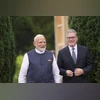 "Ramgoolam, Starmer, and probably Putin: Hosting world leaders outside Delhi")


 Connect with us on WhatsApp