
One year on, Atal Setu registers average daily traffic of 22,689 vehicles
Prime Minister Narendra Modi inaugurated the nearly 22-km-long bridge, which connects Sewri in Mumbai to Chirle in Navi Mumbai, on January 12
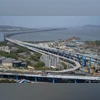 "One year on, Atal Setu registers average daily traffic of 22,689 vehicles")
Explore Business Standard

Associate Sponsors
Co-sponsor
Prime Minister Narendra Modi inaugurated the nearly 22-km-long bridge, which connects Sewri in Mumbai to Chirle in Navi Mumbai, on January 12
India's longest sea bridge Atal Setu, inaugurated a year ago, recorded an average traffic of fewer than 23,000 vehicles per day, lower than the initiation projections of handling more than 56,000 vehicles daily.
Prime Minister Narendra Modi inaugurated the nearly 22-km-long bridge, which connects Sewri in Mumbai to Chirle in Navi Mumbai, on January 12, 2024, marking the completion of a major infrastructure project in Maharashtra.
Built at a cost of about Rs 17,840 crore, the Atal Bihari Vajpayee Sewri-Nhava Sheva Atal Setu is the longest bridge in India and also the longest such structure on sea in the country.
In a release on Monday, the Mumbai Metropolitan Region Development Authority (MMRDA) said the Atal Setu (formerly Mumbai Trans Harbour Link or MTHL) was "emerging as a symbol of modern infrastructure, safety, and efficiency".
The bridge, that crosses over the Thane creek, facilitated the movement of 83,06,009 vehicles over the past year, significantly contributing to smoother and faster transit between Mumbai and Navi Mumbai, the state-run agency said.
As per a MMRDA report, on an average 57,525 vehicles were projected to use the bridge daily by 2021 (the structure was inaugurated after much delays) and 88,550 by 2031.
With an average daily traffic of 22,689 vehicles since its inauguration, the bridge witnessed its highest single-day count of 61,807 on January 14, 2024, just after it was thrown open for people's use, the release said.
As many as 77,28,149 cars, 99,660 mini buses and LCVs, 1,17,604 buses and two-axle trucks, 1,99,636 three-axle vehicles, 1,60,061 four to six-axle ones and 899 over dimensions vehicles used the Atal Setu in the last one year, the MMRDA pointed out.
"In just one year, it has transformed the commuting experience for over eight million vehicles, contributing significantly to the economic and social development of the region," the release quoted Chief Minister Devendra Fadnavis as saying.
The Atal Setu's robust traffic management and emergency response systems, comprising the Advanced Traffic Management System (ATMS), Fire-Rescue Vehicles (FRVs), maintenance teams, and patrolling units, have ensured seamless operations and swift incident handling, the release said.
"Three specialised teams work 24/7 to monitor traffic, provide medical aid (in case of injuries), and clear disruptions, minimising hazards and maintaining high safety standards," it stated.
The six-lane bridge, having about 16.5 km length over the sea and 5.5 km on land, is also meant to provide faster connectivity between the Mumbai International Airport and the upcoming Navi Mumbai International Airport (expected to be operational later this year).
It has reduced the travel time from Mumbai to Pune, Goa and South India, besides improving connectivity between Mumbai Port and Jawaharlal Nehru Port.
First Published: Jan 14 2025 | 6:45 AM IST

