Union minister Rajeev Chandrasekhar on Wednesday said some gaming companies "gamed the system", masqueraded as gaming companies to run gambling businesses or did not pay taxes at all in the past.
In his comments at Express Adda Live event amid a row over the GST Council's decision to charge 28 per cent tax on online gaming, the Minister of State for Electronics and Information Technology reiterated that he will pitch for lowering the GST on permissible online gaming and has spoken to finance minister Nirmala Sitharaman about the same.
Denying that the GST decision to be a "body blow" for the sector as it is made out to be, the entrepreneur-turned politician said there have been "bad actors" in online gaming and states who voted to levy the high GST are conditioned based on the instances that they see.
"For all of the characterization of body blow, we are upset (with the GST Council decision), there have been people who have gamed the system as gaming companies," he said.
"Some of these platforms have masqueraded as gaming and done gambling. Some of these platforms have masqueraded as gaming and not paid GST at all, even at 18 per cent," he added.
Chandrasekhar said he knows of a "bad actor" in his own state of Karnataka itself, who has gamed the system and made lots of money on which he has not paid any GST.
He said there is a general tendency among governments to look at online gambling and online gaming as a surrogate of gambling and hence, as a social evil which makes both the Centre and states to act against it and ensure that it does not grow.
The minister reminded that his ministry has been engaged in distinguishing between what is permissible and non-permissible, and "we should ideally have a system where the latter is taxed punitively with the intent of discouraging while the former should enjoy lower taxation to encourage innovation and job creation".
About the government's move towards setting up a fact-checking unit, Chandrasekhar said such a unit is required in a system where there is no accountability on a platform.
"Misinformation is no longer an academic issue, it is being weaponised by state actors, by vested interests and it is causing real problems... and every responsible government has as much of a responsibility to protect its citizens from this type of backlash of misinformation, consequences of weaponsisation of misinformation as they do to freedom of speech," he said.
"The right to free speech as enshrined in Article 19 is not to be conflated or equated with the right to misinform. Misinformation harms people," he said, adding that this is the way the state is arguing its case in the courts.
He also said that there is an asymmetry between big tech firms and content creators, and the upcoming Digital India Act envisages to correct the same by ensuring that the entity which sweats out to create content gets its dues from the big techs.
In light of concerns on corporate governance at edtech company Byju's, Chandrasekhar said he has met venture capital funds and told them about the need to mentor startup founders so that good companies get built.
The minister also spoke about social media platform Twitter, saying the government's relationship with the platform is not adversarial.
"Don't distract the whole process of building a trillion dollar economy by saying somebody threatened somebody to go to jail and all of that nonsense. That is all unnecessary," he said.
He also said that the emergence of the 'recruitment scam' at country's largest tech firm TCS was "surprising and disappointing".
The minister also said that the Foxconn-Vedanta deal shelving is not a blow but can actually be good because both the companies are now looking at independently setting up fab units.
"All things equal, this is actually good thing for a country where both the partners who are valued investors in India, who continue to invest in other parts of the economy and create jobs, want to pursue their semi-conductors (biz) independently," he said.


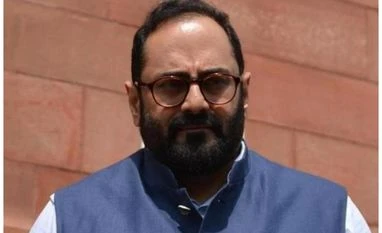 "Some gambling firms masqueraded as gaming companies: Chandrasekhar")

