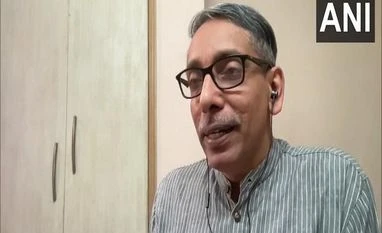
“There is no merit in their hue and cry", UGC Chairman Jagadesh Kumar said in a statement on Friday criticising academicians for their objection regarding the rationalisation of NCERT textbooks.
“In the recent past, the attacks by some "academicians" on NCERT for revising the textbooks are unwarranted,” the UGC chief said highlighting that the current textbook modifications are not the only ones carried out.
The UGC chief’s remarks come a day after a group of academicians wrote to the council demanding their names be dropped from textbooks as their "collective effort is in jeopardy". The said academicians were part of the textbook development committees of the National Council of Educational Research and Training (NCERT).
Story so far
Few days back, two former NCERT advisors, Yogendra Yadav and Suhas Palshikar, asked the NCERT to drop their names from textbooks citing "several substantive revisions of the original texts". In a joint letter, Yadav and Palshikar asserted that the presence of their names as chief advisors represents their endorsement of the changes made. However, they are against the changes and called them "arbitrary and irrational".
Following this, some 33 other academicians who were also a part of the NCERT’s textbook development committees, asked the council to remove their names from the current textbooks.
In reply to these objections, the UGC chief commented that ‘NCERT has been revising textbooks from time to time in the past too. NCERT is fully justified in carrying out the rationalization of its textbook contents.’
‘The NCERT has repeatedly stated that the revision of textbooks originates from various stakeholders' feedback and suggestions. The objective behind their grumbling seems to be other than academic reasons,’ Kumar said.
"The NCERT has also confirmed that it is developing a new set of textbooks based on the recently launched National Curriculum Framework for School Education and that current textbooks in which the contents have been rationalised to reduce the academic load are only a temporary phase," he stated.
What changes has NCERT made to the textbooks?
Earlier, the council had decided to take away certain topics from books prescribed for Class 10 students including the periodic table, democracy, political parties, and sources of energy, among others. It removed portions like Euclid's division lemma and Pythagoras' theorem from the Class 10 mathematics curriculum.
The chapter on heredity and evolution saw certain omissions with items like a box on Charles Darwin and the Origin of Life being removed. Moreover, changes were also made to the chapter on gender, religion and caste as a part of the 'rationalisation' exercise. A full page was taken off from the chapter on political parties.
Other than this, portions from the class 11 sociology textbook that talked about the 2002 Gujarat riots were also removed.
The NCERT council has also introduced several changes to books including in subjects like Political Science and History. Changes made to the class 12 history textbook include certain portions on Mahatma Gandhi and how his pursuit of Hindu-Muslim unity "provoked Hindu extremists", and a ban on the Rashtriya Swayamsevak Sangh (RSS).
Backlash from the academia
On Thursday, as many as 73 academicians, including vice-chancellors of central universities, NIT directors and IIM chairpersons, termed the withdrawal of names over the NCERT textbook row a "spectacle" by some "arrogant and self-interested" people.
They also alleged that it was disrupting the much-needed curriculum updation process.
The dropping of several topics and portions from NCERT textbooks last month triggered a controversy, with the Opposition blaming the BJP-led Centre of "whitewashing with a vengeance".
NCERT’s take
While the changes made as part of the rationalisation exercise were notified, some of the controversial deletions were not mentioned. This led to allegations about a bid to delete these portions surreptitiously.
Describing the omissions as a possible oversight, NCERT refused to undo the deletions, noting that they were based on the recommendations of experts.
Further, it also said the textbooks were anyway headed for revision in 2024, the year when the National Curriculum Framework begins. However, it subsequently changed its stand and said "Minor changes need not be notified".

 "NCERT's textbooks rationalisation: UGC chief slams academicians' objections")

