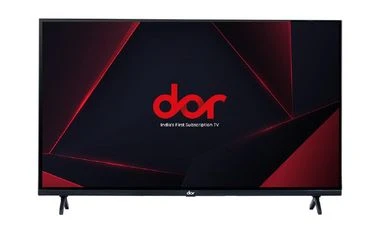
A new idea for television was announced on Tuesday. Dor, a 43-inch, Rs 10,799 TV offers 24 streaming apps such as SonyLIV, Amazon Prime Video, Disney+Hotstar, and over 300 channels, with a single subscription and sign-on. These are free for the first month. For the next 11 months, you pay Rs 799. After that the price changes, depending on how many apps you want to keep.
You could opt for free channels and YouTube, and not pay anything. Dor’s search works across apps. For instance, you could look for a Shah Rukh Khan film, or an action film, or a comedy across every app on a single screen.
“The idea is to help viewers to stop searching and start watching. We are building our own Apple-like ecosystem for content discovery and eventually everything that goes with it (e-commerce, advertising, etc.),” says Anuj Gandhi, founder and CEO, StreamBox Media.
Its main product is operating system Dor, which powers the eponymous TV. This could be licensed to any TV manufacturer. StreamBox is majority-funded and owned by consumer electronics firm Micromax Informatics along with Nikhil Kamath (Zerodha) and Stride Ventures (a debt fund).
“The whole TV ecosystem is very fragmented. You buy a TV separately, you buy different apps, a dish or a cable connection. Our idea is if the whole consumption pattern has to evolve, then everything has to come together and work seamlessly,” says Rahul Sharma, co-founder, Micromax.
Dor, which launches on December 1 on Flipkart, could just be the trigger the stagnant smart (internet-enabled) TV market needs. For over a year now, India has been stuck at 50 million smart TVs. Of this, only 35 million are truly connected – that is they use the internet to watch all types of video.
That translates into an audience of roughly 168 million people. If smart TVs are to revolutionise video-viewing and monetisation the way the mobile did, they need to reach all of India’s 900 million television viewers (in over 200 million homes), and all the 523 million people watching video online, going by Comscore data. That is when broadcasting, streaming
and user-generated video would blend into one seamless video market. Currently, the Rs 70,000 crore (ad plus pay revenue) television and the Rs 31,000 crore streaming business operate in silos.
“India’s smart TV homes are concentrated in higher-income households. There is a price-point question,” says Daoud Jackson, senior analyst at UK-based research and advisory firm Omdia.
Most 43-inch TVs cost anywhere between Rs 15,000 and Rs 50,000 each. Add subscriptions to premium apps, that is another Rs 1,500 a month. Dor then talks to a whole middle segment that is consuming billions of hours of video on the mobile, say analysts. As it becomes available in more sizes and at retail outlets, Gandhi expects the brand to hit 2 million sets in sales in two years.
The CTV advertising challenge
The price advertisers pay to reach every thousand viewers on Connected TV (CTV) is twice that on a mobile phone, according to data from Lodestar UM, a media-buying agency. This is because through the landing page of a Samsung or LG TV, they can reach audiences who were lost to pay OTTs. Last week, LG Channels, which offers 70 popular channels on LG TV, announced a partnership with Moloco for streaming ad solutions. The 10-year-old Silicon Valley-based Moloco’s machine learning platform has been used for advertising in e-commerce, gaming, streaming, and on CTVs.
“When affluent audiences watch premium content, it is more on CTV than on phone,” says Siddharth Jhawar, country manager, India, Moloco.
The fill rates (amount of ad inventory being used) on CTV is a massive 80 per cent compared to 40-50 per cent on the mobile. “On the mobile, you click, go somewhere, follow up, and buy. All of this can be tracked. The CTV proposition is very powerful but advanced use cases like targeting a relevant consumer cohort or measuring outcomes of an ad campaign are tougher,” says Jhawar.
Gandhi reckons that “marrying multiple screens” is precisely the challenge Dor addresses. For instance, “if you are watching cricket and don’t want to leave the screen, you could check the menu and order through Zomato (or any other app) from a small part of your screen. That is what we are working towards,” says he.
The second challenge is “for broadcasting or streaming firms to be able to give away good quality premium content. They might prefer not being disintermediated,” says Jhawar.
Does that explain why Netflix is still not on Dor? Gandhi says a deal with Netflix is in the works.
“For most SVoD (subscription video-on-demand) brands, the challenge is churn. If there is convenience, it helps manage churn,” says he.
Skyglass TV from Sky in the UK is a similar example though it is not clear whether it worked. In five years, half of India’s 200-odd-million TV homes are expected to be connected.

 "Future of television, smart and networked: Is Dor the disruption it needs?")












