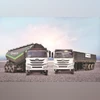
Govt plans cheap gas lifeline for LNG trucks; aims to revive closed outlets

Indian Oil, the largest operator of LNG truck outlets, has shut five of its six outlets for lack of business, with only one in Sriperumbudur, an industrial area outside Chennai, still operational

The idea is not new. State-run Petronet LNG, India's biggest LNG importer, has harboured plans of using the fuel in the transport sector for the past six years. But lack of government incentives and resistance from small transporters meant that thoug
After Indian Oil’s closures, there are fewer than 20 LNG fuel retail outlets in operation for what was until recently seen as a sunshine industry and a pollution cleanser.
S Dinakar Chennai
4 min read Last Updated : Apr 14 2025 | 12:01 AM IST
The government is considering the allocation of cheap, locally produced natural gas to trucks running on liquefied natural gas (LNG) — India’s new gas demand centre and a cleaner alternative to the country’s polluting diesel-based transport — after state-run refiner Indian Oil was forced to shut nearly all its LNG retail outlets due to high costs and a low customer turnout, industry sources told Business Standard. 
Indian Oil, the largest operator of LNG truck outlets, has shut five of its six outlets for lack of business, with only one in Sriperumbudur, an industrial area outside Chennai, still operational. Another seven-eight outlets are ready but have not started operations due to a shortage of LNG-fuelled trucks, a company official said. The firm hopes to restart the outlets if it can secure adequate refuelling demand, the official added. Indian Oil declined to comment.  
Oil-ministry officials are considering the allocation of 500,000 cubic metres of gas per day (mmcm/d) — about 0.5 per cent of India’s stagnant domestic gas production and half of what the industry had sought — from fields under the administered pricing mechanism (APM) to LNG retail outlets, according to documents reviewed by Business Standard and two industry participants.  At $6.75 per million British thermal units (mmBtu), APM gas costs about half as much as imported LNG. LNG needs to be delivered at $8-9 per mmBtu to break even operationally, officials from a state-run refiner said — a third lower than spot LNG prices. The government’s allocation should meet the annual fuel needs of 5,000 trucks, industry sources said. There are hardly 700 trucks plying today in India, compared to nearly 900,000 in China, and industry officials say with the right push from the government India can put 100,000 LNG trucks on the road, eliminating millions of tons in emission and adding gas demand of around 11 mmcm/d. 
After Indian Oil’s closures, there are fewer than 20 LNG fuel retail outlets in operation for what was until recently seen as a sunshine industry and a pollution cleanser. 
 
China, by comparison, has around 6,000 outlets. It recently announced a subsidy scheme for purchasing LNG trucks along with plans to increase LNG retailing stations to 8,000 in the next few years, industry data showed. 
The new Chinese subsidies would apply from January 1, 2025, to December 31, 2025, with a truck owner getting a maximum subsidy of 110,000 yuan ($15,100) to scrap a heavy-duty truck and buy an LNG truck, United Kingdom-based market intelligence agency Energy Intelligence said. India gives zero subsidy to the LNG truck sector. 
Indian Oil was forced to stop operations as losses from running the facility far outweighed the benefits of having a presence in the sector, industry sources said. 
Capital costs were high and so were operational losses. LNG retail outlets cost ₹5-8 crore, several times more than a petrol retail station, burdening operators with huge sunk costs. But operational costs are a killer because LNG, a cryogenic fuel stored at -162 degree centigrade, presents a unique problem. The liquefied fuel tends to evaporate in a process called “boiloff”. ‘’We lose 500-600 kg of fuel because of lack of customers,’’ an official at a state-refiner said. 
Indian Oil’s Chennai outlet has a fuelling contract with Concor and manages average sales of 2-3 tonnes a day, with extreme volatility. 
“You need consistent sales of 5-6 tonnes per outlet on a daily basis to cover boiloff costs for an operational breakeven and twice those volumes to make profits,’’ the official said. 
Another state-run refiner pointed to a paucity of trucks and long lead times for new orders at Essar’s Blue Energy, Tata Motors, and Volvo. 
The Essar group is planning to create an LNG-trucking ecosystem. GreenLine Mobility Solutions, an Essar venture, has announced a $275 million equity investment to decarbonise heavy trucking in India, including a $20 million investment from broker Zerodha founder Nikhil Kamath, to deploy over 10,000 LNG and electric trucks.

One subscription. Two world-class reads.

Already subscribed? Log in

Subscribe to read the full story →
*Subscribe to Business Standard digital and get complimentary access to The New York Times

Smart Quarterly

₹900

3 Months

₹300/Month

SAVE 25%

Smart Essential

₹2,700

1 Year

₹225/Month

SAVE 46%
*Complimentary New York Times access for the 2nd year will be given after 12 months

Super Saver

₹3,900

2 Years

₹162/Month

Subscribe

Renews automatically, cancel anytime

Here’s what’s included in our digital subscription plans

Exclusive premium stories online

  • Over 30 premium stories daily, handpicked by our editors

Complimentary Access to The New York Times

  • News, Games, Cooking, Audio, Wirecutter & The Athletic

Business Standard Epaper

  • Digital replica of our daily newspaper — with options to read, save, and share

Curated Newsletters

  • Insights on markets, finance, politics, tech, and more delivered to your inbox

Market Analysis & Investment Insights

  • In-depth market analysis & insights with access to The Smart Investor

Archives

  • Repository of articles and publications dating back to 1997

Ad-free Reading

  • Uninterrupted reading experience with no advertisements

Seamless Access Across All Devices

  • Access Business Standard across devices — mobile, tablet, or PC, via web or app

Topics :natural gasLNGIndian Oiloil and gas sectorLiquefied Natural Gas

Next Story