India’s widebody aircraft fleet has remained stagnant over the past 15 years, in sharp contrast with the expanding fleets of carriers like Emirates, Qatar Airways and Singapore Airlines.
This disparity has enabled these foreign airlines to efficiently transport a substantial volume of international passengers to and from India through their one-stop flight services.
“From 2010 until now, there has been a virtual freeze of long and ultra-long haul capacity by Indian carriers, despite India's GDP increasing 2.5x and GDP per capita by 2.2x. India is perhaps the only high-potential market with such strategic capacity constraints,” Kapil Kaul, chief executive officer (CEO) and director, CAPA India, said on Thursday.
Indian carriers currently operate 67 widebody planes, which is less than 10 per cent of their total fleet. In contrast, Emirates and Qatar Airways operate 260 and 216 widebody planes, respectively.
Widebody aircraft have larger fuel tanks and engines compared to narrowbody aircraft, enabling them to fly on longer routes such as India-US, India-Europe and India-Oceania.
Around 80 per cent of Qatar Airways' traffic to and from India consists of “sixth freedom traffic,” while approximately 60 per cent of Emirates' traffic to and from India falls into this category.
Sixth freedom traffic refers to passengers travelling between two foreign countries via a third country's airline hub (such as Doha or Dubai) as a stopover.
Last month, Air India's CEO and managing director (MD), Campbell Wilson pointed out this phenomenon.
According to Wilson, airlines domiciled around India have survived due to Air India's weakness. But he added the carrier now has an opportunity to reclaim the market from them and establish the country as a hub for travellers.
On Thursday, IndiGo placed an order with European plane maker Airbus for 30 A350-900 widebody aircraft, estimated to be worth $4-5 billion.
In February 2023, the Tata-run Air India group placed an order for 470 planes, comprising 250 Airbus and 220 from American plane maker Boeing. Of these, 470, 70 would be widebody planes.
Kaul on Thursday said: “Estimating the impact of almost 15 years of capacity freeze is difficult, but the right time to realise the potential upside is over the next two years. India's long and ultra-long haul market requires the deployment of 130-140 widebody aircraft as of today, to handle over 20 million passengers.”
“About 60 widebody aircraft must be deployed just on the India-US route itself,” he added. He said this while highlighting the significant demand generated by approximately six million passengers travelling between India and the US each year.
“By 2031-32, the long and ultra-long haul market needs the deployment of around 300 widebodies (up from 130-140 currently). India-US alone will require 100 widebody equivalents,” Kaul noted.
Indian passengers seem to be price sensitive with respect to travelling on Indian carriers, but far less so when it comes to foreign carriers such as Emirates, British Airways, Qatar Airways and Lufthansa.
“Pricing on leading international carriers, especially until a couple of years ago, used to be much higher than on Indian carriers. Indian carriers must realise the opportunity to achieve a price premium in their home market,” Kaul said.
Indian carriers need to ensure that their travel ecosystem has the specialist capability to sell seats on long haul flights.
“This will require an overhaul of their commercial capability,” he said.
Indian carriers tend to generate 80 per cent of their international passengers from India, and 20 per cent from overseas.
“This needs to be rebalanced to around 60 per cent/40 per cent to take advantage of the higher yield of offshore points of sale, and to have greater pricing power at home,” he noted.
Kaul said the corporate travel programmes (specific incentives and benefits offered to corporate customers) should be re-assessed.
“Given that Indian carriers can offer non-stop connectivity, which will be coupled with improved product and service quality, the benefits that are offered and the associated costs and impact on yield need to be rationalised,” he said.

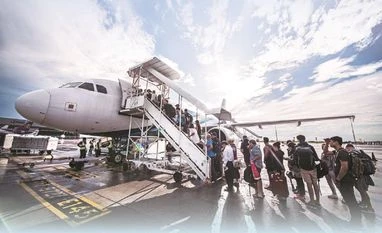 "India's widebody aircraft fleet has remained stagnant for last 15 years")


