Textile hub Tiruppur threads a recovery on sliding rupee as exports surge

What's driving this surge? Partly, it's the rupee's depreciation versus the dollar, down nearly 3 per cent in 2024, which has made India's exports more attractive on the global stage

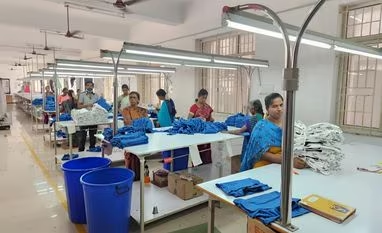
Workers at a manufacturing unit in Tiruppur  Source: Premier Agencies
Workers at a manufacturing unit in Tiruppur | Source: Premier Agencies
Shine Jacob Chennai
3 min read Last Updated : Jan 06 2025 | 10:54 PM IST
In the shadows of a sliding rupee, India’s knitwear hub Tiruppur is weaving a success story.
 
While the domestic currency edges closer to the 86 mark against the US dollar, triggering concerns for many sectors, this textile town in Tamil Nadu is finding opportunity in adversity: Between April and December alone, Tiruppur’s exports reached Rs 26,000 crore, almost eclipsing last financial year’s total of Rs 30,690 crore.
 
The final tally for 2024-25, based on conservative estimates, could soar as high as Rs 35,000-40,000 crore. Tiruppur accounts for 55 per cent of India’s knitwear exports.
 
What’s driving this surge? Partly, it’s the rupee’s depreciation versus the dollar, down nearly 3 per cent in 2024, which has made India’s exports more attractive on the global stage. According to the Tiruppur Exporters’ Association (TEA), the rupee’s decline against the dollar last calendar year alone accounts for about 5 per cent of this growth. 
 
And it’s not just Tiruppur: Indian exports as a whole have been buoyant, with apparel exports jumping 10 per cent in November compared to the same month last year, hitting $1.1 billion. 
 
Major export markets, such as the US, the EU, and the UK, have all registered strong import growth, spurring orders from global retail giants. “We have already crossed the Rs 26,000 crore mark this financial year, and with three months to go, we could even touch Rs 40,000 crore,” said K M Subramanian, president of the TEA. The list of buyers is a roll call of global heavyweights: Primark, Tesco, Next, Marks & Spencer, Warner Bros, Walmart, and Tommy Hilfiger. Australian brands like Target and Woolworths, along with European players like Duns, have also placed significant orders. 
 
The United Arab Emirates has emerged as a key player, thanks to a free-trade agreement enabling easier exports to Africa via West Asia. “We are seeing good demand from the UAE, which has become an important gateway,” Subramanian said.
 
But currency movements tell only part of the story. Tiruppur has caught the attention of global buyers prioritising ESG (environmental, social, and governance) compliance. The town boasts a carbon-negative status, achieved through substantial investments in green energy, zero liquid discharge systems, and large-scale tree plantations.
 
Tiruppur’s recovery is also rooted in its embrace of technology. The adoption of AI-driven manufacturing has significantly increased productivity, raising production capacity from 45 per cent to 65 per cent. This modernisation follows a difficult year in 2023-24, when the region saw an 11 per cent drop in exports to Rs 30,690 crore, a steep decline from Rs 34,350 crore in 2022-23. The downturn was attributed to global disruptions: The war in Ukraine, financial instability in Europe and the US, and the fallout of supply chain crises. 
 
Geopolitical shifts are further aiding Tiruppur’s fortunes. The “China Plus One” strategy, which encourages companies to diversify supply chains away from China, Subramanian said, is steering business toward India. Meanwhile, political instability in Bangladesh, another major textile hub, has added to the momentum. 
 
“October was a standout month,” said Sanjay K Jain, managing director of TT Limited and chairman of the Indian Chambers of Commerce’s National Committee. “The US registered a 22 per cent year-on-year rise in imports, and the EU saw a similar 22 per cent jump; the UK logged a 5 per cent increase. This reflected in the exports from all major players like India, China, Bangladesh, and Vietnam... The rupee depreciation will benefit the entire textile chain, with around 50 per cent of the gain passed on to the buyers.”

One subscription. Two world-class reads.

Already subscribed? Log in

Subscribe to read the full story →
*Subscribe to Business Standard digital and get complimentary access to The New York Times

Smart Quarterly

₹900

3 Months

₹300/Month

SAVE 25%

Smart Essential

₹2,700

1 Year

₹225/Month

SAVE 46%
*Complimentary New York Times access for the 2nd year will be given after 12 months

Super Saver

₹3,900

2 Years

₹162/Month

Subscribe

Renews automatically, cancel anytime

Here’s what’s included in our digital subscription plans

Exclusive premium stories online

  • Over 30 premium stories daily, handpicked by our editors

Complimentary Access to The New York Times

  • News, Games, Cooking, Audio, Wirecutter & The Athletic

Business Standard Epaper

  • Digital replica of our daily newspaper — with options to read, save, and share

Curated Newsletters

  • Insights on markets, finance, politics, tech, and more delivered to your inbox

Market Analysis & Investment Insights

  • In-depth market analysis & insights with access to The Smart Investor

Archives

  • Repository of articles and publications dating back to 1997

Ad-free Reading

  • Uninterrupted reading experience with no advertisements

Seamless Access Across All Devices

  • Access Business Standard across devices — mobile, tablet, or PC, via web or app

Topics :Textile exportstextile industryTirupurIndian rupee

Next Story