The stunned look of disbelief on Barry Richards’ face said it all. In one hand, the extravagantly gifted former South African opener was holding the bat with which he scored 325 runs in a single day in a Sheffield Shield game in 1970. In the other, he gripped David Warner’s modern-day weapon — the iconic Kaboom. Richards’ bat from a bygone era was slim and understated, while the Kaboom had massive edges, light pickup, and unmatched power. The contrast could not have been more staggering.
In 2015, Richards called for a serious reassessment of bat technology to restore parity between bat and ball. A decade later, the Board of Control for Cricket in India (BCCI) has finally decided to crack the whip on the growing heft of the cricket bat.
This Indian Premier League (IPL) season, the administrators have decided to check bat sizes on match days using a standard gauge — a rectangular tool with a house-shaped cutout. A bat must pass through this gauge — including any permitted coverings or toe guards — to be deemed fit for play.
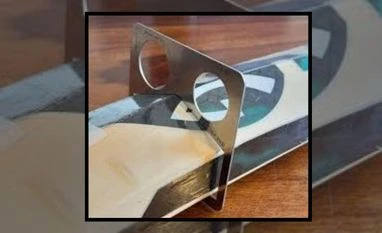
The IPL adopted this rule from the England and Wales Cricket Board, which introduced bat size checks in 2018 to enforce Marylebone Cricket Club (MCC) Law 5. The law limits bat dimensions to a 4 cm edge, 6.7 cm depth, and 10.8 cm width.
In the past, bats were heavier due to their moisture content. But with the rapid commercialisation of the sport, modern bat makers have flipped the script. By removing moisture, they’ve packed in more wood, creating bats with massive edges and enlarged sweet spots.
Today’s cricket bats have edges that are as massive as the sweet spots of Donald Bradman’s bat. Consequently, contemporary players rely on muscle rather than finesse, swinging for power rather than placement. Batters today resemble more like golfers, with their wide, exaggerated swing. The oversized bat has stripped cricket of its subtle art — the touch game.
In his pomp, Richards’ power came from impeccable timing, nimble footwork, and brilliant technique. He played the ball late, using the bowler’s pace to guide it into gaps. Observers often say Richards didn’t even need a bat to face Dennis Lillee and Len Pascoe — two of Australia’s most fearsome bowlers. Legend has it, he could have managed with just a picket from the Adelaide Oval’s fence.
Richards was one of the finest exponents of the touch game. His batsmanship was defined by his whole body working in sync, rather than relying on brute force. Over time, the indiscriminate growth in the size of the bats have skewed the game heavily in favour of the batters, leaving bowlers as mute spectators.
It has taken the pitch — and other external factors — out of the equation. As a result, sixes are flying, batting records are tumbling, and a 300-run total seems imminent in an IPL game. Bowlers, on their part, have unleashed a slew of variations like the knuckle ball to con batters, but to no avail.
IPL’s governing body has allowed bowlers to use saliva to shine the cricket ball in this season, reversing a ban that was imposed during the pandemic four years ago. Saliva aids traditional and reverse swing, and the move is seen as a welcome step towards giving more ammunition to the bowlers.
Nevertheless, it remains to be seen whether the International Cricket Council (ICC), the game’s custodian, will lift the saliva ban for Test cricket. More needs to be done — especially in the 50-over format, where the use of two new balls keeps them harder for longer, allowing batters to hit through the line with ease and effectively nullifying reverse swing.
Mohammed Shami, India’s ace fast bowler, had urged the ICC to lift the ban. After India’s win over Australia in this year’s Champions Trophy semi-final, he said: “We keep appealing that we should be allowed to use saliva so that we can bring reverse swing back into the game.”
The ICC needs to understand that spectators will continue to flock stadiums and remain glued to their television sets and mobile phones even if a fast bowler sends the stumps flying. After a point, high-scoring games can become desultory affairs. The real spectacle is in the see-sawing, low-scoring nail-biters, where the balance shifts with every ball.
The ICC must be proactive in restoring the balance between bat and ball. Or else, as South Africa’s premier fast bowler Kagiso Rabada aptly put it, “You might as well call our sport batting and not cricket.”




