India's G20 opportunities

V Srinivas's book puts the spotlight on India's priorities and challenges, as it steers the G20 presidency
Chart
Dammu Ravi
5 min read Last Updated : Apr 13 2023 | 12:01 AM IST
Logic dictates that in an increasingly interdependent 21st century, common approaches and collective actions are imperative for tackling global challenges that have consequential impact on other parts of the world. The G20, representing 85 per cent of global gross domestic product, 75 per cent of global trade and two-thirds of the global population, can take on this mantle of responsibility to shape the global discourse and put in place a programme of action for addressing those challenges. It draws its heft from wider representation, beyond its permanent 20 members, including an equal number of invitees from developing countries and international organisations.

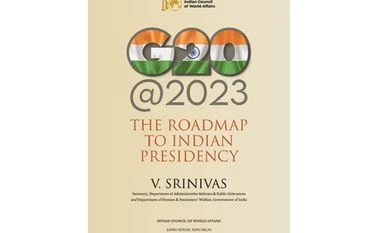
This year is India’s moment on the world stage as it steers the G20 presidency with widespread expectations of its ability to build consensus, even as differences persist due to geopolitical tensions. V Srinivas’s erudite book G20@2023: The Roadmap to Indian Presidency puts the spotlight on India’s priorities and challenges, drawing insights from the practical lens of an officer who was witness to diplomatic dynamics at play in multilateral institutions at close quarters as chief staff officer to India’s finance and foreign ministers and later as advisor to the executive director of the International Monetary Fund from 2001 to 2006.

The book brings out rare insights into how each country managed its G20 presidency priorities through agonising rounds of negotiations for achieving consensus. In 2017, Angela Merkel was determined to move forward without the US on board with the Paris Deal when Donald Trump withdrew from it.  India’s commitment to “Net Zero 2070” at Glasgow COP-26 in 2021 denotes a leap of faith. The “Ósaka Track” on Data Free Flow with Trust (DFFT) initiative in 2019 was a priority for Japan in which India had kept out, but appears to have moved closer now going by the draft Data Protection Bill. The extraordinary Leaders Summit in March 2020 under the Saudi Presidency responded to the devastating Covid pandemic through a well-coordinated action plan in which India’s supply of medicines and vaccines was greatly appreciated. The Debt Service Suspension Initiative (DSSI) under the Italian Presidency in 2021 provided temporary succour for developing countries, while the Russia-Ukraine conflict proved to be a spanner in the works of the Indonesian Presidency.

Much as the author would like us to believe that G20 averted a second Great Depression in 2009 with timely bailout packages and regulatory oversight, the issue of sovereign debt burden continues to hang like a Damocles’ sword over much of the developing world. The long pending reforms of the Bretton Woods institutions, crucial to injecting resilience and stimulating economic recovery in the developing world, remains elusive. Failure to address this contentious issue runs the risk of conceding space to new financial institutions such as the New Development Bank and Asian Infrastructure Investment Bank, as well as to individual countries with deep pockets.

Mr Srinivas’s optimism in India’s ability to lead G20 from the front stems from his understanding of India’s contribution to multilateralism and democracy with its inclusive governance model that is worthy of emulation. India’s G20 Presidency is a watershed moment, coinciding with Amrit Kaal, which makes it both futuristic and inclusive. The theme “One Earth, one Family, One Future” reflects a notion of universal brotherhood in sync with the principles of the UN Charter. For enduring peace, progress and prosperity in the world multilateral rules are not only imperative but also need to reflect contemporary realities. Aptly so, for India, “Reforming Multilateralism” is a priority under its Presidency.

It is notable that India’s key priorities under its G20 Presidency brings “development” to the centrestage of the global discourse. The “Voice of Global South Summit” held virtually by India last January 2023 with enthusiastic participation from 128 developing countries enabled discussion on the development dimension in different hues. This perspective is an opportunity for India to redefine the Western narrative on global issues — “women led development” can help accelerate realisation of Sustainable Development Goals; discussion on climate change and environmental sustainability is incomplete without LiFE (Lifestyle for Environment); renewable energy technologies are critical for energy transition; and “digital public goods” can play a key  role in economic transformation. The new engagement group of “start-ups”  is expected to spur innovation across borders.

During India’s G20 Presidency more than 200 meetings covering 55 cities are being organised, showcasing India’s progress, vibrancy and diversity. Beyond diplomatic opportunity for India, it is a new responsibility and measure of the world’s trust in India’s ability to steer the emergent new global order in a post-Covid world, Mr Srinivas asserts.

A significant part of the book is a compendium of Outcome Documents, Joint Communiqués, Summit Declarations of various G20 presidencies, which will serve as a useful source of information at one place for scholars, academia, think tanks and budding UPSC aspirants. The book would have made a greater impact had it carried the author’s objective analysis on the challenging issues in G20. Perhaps he could attempt these issues in a sequel.
 
The reviewer is a serving Indian Foreign Service officer

One subscription. Two world-class reads.

Already subscribed? Log in

Subscribe to read the full story →
*Subscribe to Business Standard digital and get complimentary access to The New York Times

Smart Quarterly

₹900

3 Months

₹300/Month

SAVE 25%

Smart Essential

₹2,700

1 Year

₹225/Month

SAVE 46%
*Complimentary New York Times access for the 2nd year will be given after 12 months

Super Saver

₹3,900

2 Years

₹162/Month

Subscribe

Renews automatically, cancel anytime

Here’s what’s included in our digital subscription plans

Exclusive premium stories online

  • Over 30 premium stories daily, handpicked by our editors

Complimentary Access to The New York Times

  • News, Games, Cooking, Audio, Wirecutter & The Athletic

Business Standard Epaper

  • Digital replica of our daily newspaper — with options to read, save, and share

Curated Newsletters

  • Insights on markets, finance, politics, tech, and more delivered to your inbox

Market Analysis & Investment Insights

  • In-depth market analysis & insights with access to The Smart Investor

Archives

  • Repository of articles and publications dating back to 1997

Ad-free Reading

  • Uninterrupted reading experience with no advertisements

Seamless Access Across All Devices

  • Access Business Standard across devices — mobile, tablet, or PC, via web or app

Topics :BOOK REVIEWG20

Next Story



