The Finance Commission is key to saving our cities from climate change

Its current horizontal devolution formula is insufficient to prepare cities to deal with floods and droughts caused by climate change
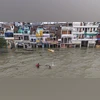
Prayagraj Flood, UP Flood, Flood
Nowhere is this climate risk more visible than in India, where Delhi reels from simultaneous flooding and heat emergencies, Punjab grapples with its worst inundation in decades (Photo:PTI)
Amit Kapoor
5 min read Last Updated : Sep 17 2025 | 10:22 PM IST
The story of cities and climate change is often narrated through the lens of a familiar set of hazards, from searing heat to flooding rivers and choking smog. While they remain grievous concerns to be addressed, Indian cities today are undergoing a quieter but more concerning shift. 
New risks are emerging not as single events but as systemic dynamics, reshaping how cities grow, infrastructure holds together, and finance is mobilised. The next decade will not only be about defending against rising seas or installing air purifiers or cooling centres; it will be about managing the flows of people, systems, and capital that determine whether cities can adapt at scale. 
One of the most profound of these shifts is migration. The World Bank’s Groundswell initiative in 2021 estimated that as many as 216 million people could be forced to move within their own countries by 2050 due to climate-related stressors. These flows are already beginning, as droughts reduce rural viability and coastal inundation drives families inland. The Intergovernmental Panel on Climate Change (IPCC) Sixth Assessment Report recognises that urban areas will become magnets for climate migrants — not because they are safe, but because they promise services, employment, and the possibility of survival. Yet too many municipalities treat migration as a crisis at the margins, rather than a central feature of climate adaptation. 
Without proactive planning, the new arrivals risk being absorbed into informal settlements located precisely in the zones most exposed to floods and landslides. It is important to note that what looks like migration pressure is, in fact, an opportunity: With foresight, urban growth spurred by mobility can build resilience, diversify economies, and reduce per-capita emissions. 
However, the integrity of urban systems themselves is becoming more precarious. The IPCC warns that climate change no longer produces isolated shocks, but compound and cascading risks. Cities, stitched together by networks of power, water, transport, and communications, are discovering that one failure often drags others down. 
Studies show that mortality can spike dramatically when cooling systems fail, especially in housing stock without passive design. Flooding, too, is no longer a matter of a swollen river or a single storm surge. High tides, heavy rainfall, and river floods increasingly coincide, creating compound inundation that overwhelms defences built to handle each hazard separately.
 
It clearly conveys that distant hazards (like upstream floods, droughts, or power grid failures) affect cities, and the problem lies in the piecemeal way risks are currently managed. The future of adaptation lies in designing for interconnectedness, embedding redundancy in critical systems, integrating green with grey infrastructure, and ensuring that health and housing policy are part of the same climate conversation as drainage canals and seawalls.
 
Money remains the toughest barrier. United Nations Environment Programme’s Adaptation Gap Report 2024 shows international public finance for adaptation reached only $28 billion in 2022, while developing countries need $194–366 billion annually. Less than 10 per cent of global climate finance goes to adaptation as mitigation dominates. Multilateral development banks committed a record $137 billion in 2024, but only $26 billion supported adaptation. Urban needs far exceed this: The World Bank estimates Indian cities require $2.4 trillion by 2050 to climate-proof infrastructure, or annual flood damages could rise from $4 billion to $30 billion. City leaders must choose between repeated rebuilding and long-term resilience that outlasts political cycles.
 
The 16th Finance Commission becomes critical in this respect. The Commission’s mandate to recommend how central tax revenues are shared with states offers a constitutional pathway to mainstream climate risk into fiscal transfers. A forward-looking climate vulnerability criterion would ensure that fast-growing but climate-exposed cities receive predictable, rule-based support for adaptation, rather than relying only on post-disaster relief.
 
The current horizontal devolution formula, while including a 10 per cent “forest and ecology” weight, remains essentially a static stock proxy and does not capture dynamic climate hazards or the avoided-loss value of resilient ecosystems. After thorough research, the Institute for Competitiveness, in its report “A Climate Risk Lens on Fiscal Devolution”, has recommended creating a dedicated 5 per cent climate-risk weight by reducing the formula weights of population (from 15 per cent to 13 per cent), area (from 15 per cent to 13 per cent), and forest and ecology (from 10 per cent to 9 per cent). This adjustment ensures that states facing heat, floods, and low adaptive capacity receive predictable, rule-based support, a change that strengthens, rather than weakens, the current devolution formula.
 
Taken together, migration, cascading failures, and the adaptation finance gap illustrate how the terrain of urban climate risk is shifting. Each reinforces the other: Unmanaged migration increases exposure, infrastructure fragility magnifies every shock, and inadequate finance leaves both problems unresolved. However, if properly reframed, these are also entry points for transformation. In 2025, the challenge is to recognise the new forms of risk that are already unfolding and to build institutions, infrastructures, and financing models that match their complexity.
 
Nowhere is this climate risk more visible than in India, where Delhi reels from simultaneous flooding and heat emergencies, Punjab grapples with its worst inundation in decades, and fast-growing metros like Bengaluru and Mumbai confront mounting infrastructure and finance deficits. These cities encapsulate the broader global challenge: Unless adaptation planning and finance keep pace with urban growth, climate impacts will magnify inequality and systemic fragility. If they do, however, India’s urban transition can also become a laboratory for resilience, offering lessons for rapidly growing cities across the Global South.
 
The author is chair, Institute for Competitiveness.   X: @kautiliya
 

One subscription. Two world-class reads.

Already subscribed? Log in

Subscribe to read the full story →
*Subscribe to Business Standard digital and get complimentary access to The New York Times

Smart Quarterly

₹900

3 Months

₹300/Month

SAVE 25%

Smart Essential

₹2,700

1 Year

₹225/Month

SAVE 46%
*Complimentary New York Times access for the 2nd year will be given after 12 months

Super Saver

₹3,900

2 Years

₹162/Month

Subscribe

Renews automatically, cancel anytime

Here’s what’s included in our digital subscription plans

Exclusive premium stories online

  • Over 30 premium stories daily, handpicked by our editors

Complimentary Access to The New York Times

  • News, Games, Cooking, Audio, Wirecutter & The Athletic

Business Standard Epaper

  • Digital replica of our daily newspaper — with options to read, save, and share

Curated Newsletters

  • Insights on markets, finance, politics, tech, and more delivered to your inbox

Market Analysis & Investment Insights

  • In-depth market analysis & insights with access to The Smart Investor

Archives

  • Repository of articles and publications dating back to 1997

Ad-free Reading

  • Uninterrupted reading experience with no advertisements

Seamless Access Across All Devices

  • Access Business Standard across devices — mobile, tablet, or PC, via web or app

Topics :Climate ChangeWorld Bank Finance CommissionUrban MigrationBS Opinion

Next Story



