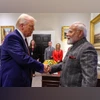
High on New Delhi’s list of objectives prior to Prime Minister Narendra Modi’s visit to Washington would have been the need to demonstrate that India is a willing and active partner for the new administration, led by President Donald Trump. Indeed, while Mr Trump was welcoming Mr Modi to Washington, his vice-president was speaking at the Munich Security Conference — a speech that effectively laid out the many ways in which the new dispensation in the US disagreed with its allies in Europe. Mr Modi’s visit will have attempted to convey that, unlike the troublesome Europeans, India is a far more congenial partner for an America being remade by a second Trump term. The positive atmosphere that Indian officials hoped to create is reflected, to an extent, in the joint statement issued following the visit. For one, when it comes to trade issues, the statement reveals a tone somewhat more cooperative than the ones the new President tends to take otherwise. It also sets out a plan for negotiations on a trade agreement — of the early-harvest sort being discussed in 2020 — to be settled before this fall. Given the degree to which trade concerns were de-emphasised in the bilateral relations over the past four years, this could be seen as an important step forward.
Such caution should also be the formula through which the rest of the joint statement is examined. While there have clearly been attempts to create new avenues for cooperation and to expand old ones in domains from critical minerals to defence, the very fact that the US must now be viewed as an unreliable partner reduces the salience of any individual move. And, in some cases, there are questions about how soon India will also be able to take advantage of any offers from the US side. For example, although the Budget promised to amend the nuclear-liability regime in India with a view to enhancing investment in that sector, timelines on such amendments, as well as their quality, are always unknown.


 "New phase in India-US ties: India will have to deal with unpredictability")











