“The future belongs to nations with grains, not guns.” This was one of MS Swaminathan’s favourite lines, according to his upcoming biography, The Man Who Fed India. The doyen of Indian agriculture firmly believed that neglecting agriculture was akin to neglecting India’s future.
To be released next week to commemorate the centenary of the Father of India’s Green Revolution, the 380-page book brings forth many unheard and unseen anecdotes, quotes, stories, and events from the life of one of India’s greatest scientists, thinkers, and institution-builders. “I realised there was an urgent need to humanise him — to bring out the man beyond the agricultural corridor,” says the author, Priyambada Jayakumar, about Swaminathan, her paternal uncle.
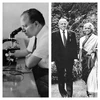
The book’s first part traces Swaminathan’s journey from his birth to his early career at the Indian Agricultural Research Institute (IARI), his interactions with the legendary American agronomist Norman Borlaug, and beautifully captures the life of a young scientist settling in New Delhi with his three daughters and his illustrious wife, Mina. The first flat the couple rented in Delhi after their marriage in 1955 was in Patel Nagar. The monthly rent was ₹130; Swaminathan’s salary at IARI was ₹450.
Mina Swaminathan, daughter of India’s finance secretary S. Bhoothalingam, was more than just her lineage — she was outspoken, independent, patriotic, and driven by a missionary zeal to serve those on the margins of society.
The book also offers intriguing insights into how Swaminathan and Mina’s paths had crossed long before their formal introduction through common friends in Cambridge. Unknown to each other, the two had marched with teeming crowds behind Mahatma Gandhi’s cortege after his assassination. At the time, Swaminathan was a postgraduate student at IARI, while Mina was still at the Convent of Jesus and Mary in Delhi.
Years later, while Swaminathan and his team would go from door to door, urging villagers to try new variants of high-yielding seeds, accompanying him would be Mina and their daughters, “who viewed going to these villages on Sunday to rally the farmers as a ‘picnic’!” the book reads.
The first chapter, titled “But, Only God Can Make a Tree,” details Swaminathan’s childhood in Monukumbu and Kumbakonam in Kerala, surrounded by his aunts and uncles, and the influence of his father’s medical profession. His early years in the 1930s were idyllic — unhurried, uncomplicated, filled with simple pleasures and a touch of mischief, the book says.
The second chapter, titled “The Bengal Famine Was Man Made,” explores the profound impact of the famine on a young Swaminathan and how it shaped the course of his life.
“The Bengal Famine of 1942–1943, which occurred during the Second World War and killed upwards of four million men, women, and children, was a watershed moment in Swaminathan’s life and completely altered the trajectory of his career and, indeed, his life,” the book details.
This famine — the only one in modern Indian history not caused by monsoon failure but by British wartime policies — was essentially man-made, orchestrated by the government of Winston Churchill. Swaminathan’s own aunt had to find alternatives to supplement their food supply. Tapioca (cassava) was often used instead of rice for at least one meal a day.
This personal experience impressed upon him the importance of a diversified and inclusive food system, often relying on underutilised crops like millets — something that would define his future research and advocacy.
Deeply disturbed by the indignity and suffering the famine caused, Swaminathan found his resolve firmed through discussions with fellow students and professors. The idea that the solutions for India lay in her own soil captured his heart and mind, and solidified his decision to study agriculture, the book states.
Civil services and back
Swaminathan found himself at another crossroads in 1949 after graduating from IARI with high distinction in cytogenetics. A newly independent India offered opportunities in bureaucratic and administrative services. With little promise of income in agricultural science, his family — particularly his mother — believed the Indian Administrative Service (IAS) would be a better fit for someone as brilliant as him.
The prestige of the civil services also weighed heavily. A respected family friend, S.V. Krishnaswamy, the collector of Kumbakonam and an Indian Civil Service officer, advised him to sit for the civil services exam, saying there was “no future in agriculture.” Swaminathan agreed, although half-heartedly.
To no one’s surprise, he cleared the exam in his first attempt. But fate had other plans.
In August 1949, he received a fellowship from Unesco to study plant genetics at Wageningen Agricultural University in Holland. He jumped at the offer, believing deeply that a future in agricultural sciences was the right choice.
Then 24, Swaminathan set sail for England and then on to Holland aboard his “ship of dreams,” the Indian liner Jal Azad — meaning “freedom of the seas.” At Wageningen, he was tasked with developing genetically resistant potato lines. The over-reliance on potatoes during the war had led to soil infected by the golden nematode pest — a challenge that would help shape his scientific thinking and approach to sustainable crop development.
Swaminathan’s time at Wageningen University came to a swift end in nine months. Toward the end of his stay, Mohan Sinha Mehta, the first ambassador of India to The Hague, informed him that the home ministry had posted him to Assam in the hope that he would reconsider joining the civil services.
Swaminathan, however, declined. His sights were firmly set on the University of Cambridge.
The food problem
In the fall of 1950, he moved to England to pursue his PhD at the Plant Breeding Institute at Cambridge University under the guidance of H.W. Howard, a fellow of Fitzwilliam College.
In the chapter titled “Malady Remedy,” the book recounts how, upon returning from abroad, while briefly assisting in his brother's new pharmaceutical venture, Swaminathan met Navalpakkam Parthasarthy, his former teacher from IARI.
Parthasarthy asked why he hadn’t stayed back in the UK. Swaminathan replied that he had job offers from the University of Wisconsin and even from the Red Dot Potato Chip Company. But he went on to add: “Sir, my heart lies in India. I went abroad to equip myself to solve India’s food problem or, at least, try. I studied genetics to be able to help India produce enough food on her own. Agricultural research, especially in genetics and breeding, was the easiest way for me to produce one good strain of crop which could then universally benefit the farmers regardless of their plot size. My stays abroad, although very fulfilling, were always meant to be temporary.”
Parthasarthy immediately offered him a position at the Central Rice Research Institute (now the National Rice Research Institute) in Cuttack. Swaminathan joined as an assistant botanist in March 1954. But fate intervened again. In October that year, one of his pending applications came through, and he was selected as assistant cytogeneticist at IARI in Delhi, where he had earlier completed his master’s.
IARI would become his “home” for the next 18 years (1954–1972), through some of the most transformative years for Indian agriculture.
However, Swaminathan faced several institutional hurdles. The book recounts an incident in 1958 when the then agriculture minister, Ajit Prasad Jain, asked scientists to spend more time in the field, without understanding the ground realities.
“This bureaucratisation of science by non-scientist ministers and officials endlessly frustrated Swaminathan, who was in a tearing rush to prove the doomsday predictions of the Paddock brothers and the Ehrlichs wrong,” the book writes. In the 1960s, the Paddock brothers and Paul Ehrlich had predicted famine and societal collapse due to overpopulation.
At IARI, Swaminathan plunged into what would define his legacy: wheat research.
The book details that while he worked on popularising new wheat varieties, his wife Mina contributed in her own way. In the village of Jaunti, she started a makeshift school from 6–11 am for local children.
A pivotal moment came when Swaminathan’s father-in-law lobbied for the clearance of critical funds to import 18,000 tonnes of high-yielding wheat seeds from Mexico — an act that laid the groundwork for India’s Green Revolution.
“Coincidentally, and rather happily for Swaminathan, the Finance Secretary of India at that time, the brilliant S. Bhoothalingam, was also his father-in-law! He lobbied and negotiated hard within the government to get the funds cleared — a princely sum of around ₹5 crore at that time! His only condition was that seeds should be delivered in time for the rabi-sowing season in 1965,” the book reads.
Another legacy project came through Swaminathan’s friendship with the physicist Vikram Sarabhai, which led to the launch of Krishi Darshan, a show for farmers, on Doordarshan on January 26, 1967. Today, Krishi Darshan is India’s longest-running television programme.
“Sarabhai very generously donated 200 television sets from the Nehru Foundation to make these films under the direction and supervision of the IARI Extension Division, which went to farmers’ fields to start shooting the footage,” the book mentions. Terminologies like ‘crop weather watch group,’ which are still in use today in Krishi Bhawan, were coined by Swaminathan some 45 years ago, it says.
On controversies, the book recounts one episode when Swaminathan was accused of publishing misleading lysine content data in a wheat variety report originally compiled by a PhD student, George Verghese, at IARI years ago. It was nothing more than an experimental error.
The matter was raised in the Lok Sabha a decade later in 1976, prompting Swaminathan to offer his resignation. Jayaprakash Narayan came to his defence, writing a letter of support to then Prime Minister Morarji Desai.
Back to research
The second phase of Swaminathan’s career began in December 1981, when he was approached by Clarence Grey, chairman of the Board of Trustees of the International Rice Research Institute (IRRI) in the Philippines, to serve as director-general.
Swaminathan, who had not applied for the position, was unanimously chosen by the IRRI board. He was the first Asian to be offered the role. “He was quite excited by this offer because it would give him a chance to get back to research — and that too in rice, a grain of vital importance in all of Asia — after working in the Planning Commission tirelessly for two years, which had frankly exhausted him,” the book reads.
The chapter “Tatay” (meaning father or big daddy) chronicles his time at IRRI, followed by the founding of the MS Swaminathan Research Foundation (MSSRF) in Chennai.
Both Karnataka chief minister Ramakrishna Hegde and Tamil Nadu chief minister M. Karunanidhi offered land and financial support to host the foundation. Swaminathan chose Chennai, guided by its 1,000 km coastline — ideal for MSSRF’s anchor project on coastal research.
The book also details Swaminathan’s global travels and the many accolades he received during his long, eventful life. He died at 98.
The later chapters reflect on Swaminathan’s dismay at seeing farmers labelled as “beneficiaries of the state” within policy circles at Krishi Bhawan. The chapter on the National Commission on Farmers laments that its recommendations remain a faint hope at best.
The book also highlights Swaminathan’s tenure in the Rajya Sabha (2007–2013), his vocal opposition to the government’s handling of the 2020 farmers’ protest, and his public support for the repeal of the controversial farm laws.
The book is yet another reminder that science, at its best, is an act of service — and few have lived that truth more fully than MS Swaminathan.


 "'Scientist of the soil': New book reveals untold stories of MS Swaminathan")









