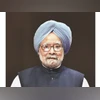
Cong veteran Manmohan Singh: Prime minister by chance, statesman by design

QUIET CRITIC: From economic reforms to political storms, ARCHIS MOHAN chronicles the journey of India's 'accidental prime minister' as he retires after 33 years in the Rajya Sabha at 91

Manmohan Singh
Archis Mohan New Delhi
7 min read Last Updated : Feb 11 2024 | 10:53 PM IST
In his final press conference as prime minister (PM) in January 2014, Manmohan Singh expressed his belief that history would be kinder to him than the contemporary media and the Opposition.

Ironically, the Narendra Modi government spent the last few days of the 17th Lok Sabha (LS), which also marked the end of Singh’s 33 years as a parliamentarian, rehabilitating the reputation of Singh’s political mentor, P V Narasimha Rao. However, it was unsparing in its criticism of Singh’s prime ministerial tenure.

On Friday, the government announced that it would posthumously award the Bharat Ratna to Rao. Modi noted that Rao’s “visionary leadership” was “instrumental in making India economically advanced, laying a solid foundation for the country’s prosperity and growth”.

Rao spent his last years ignominiously, facing corruption charges and a Congress leadership that blamed him for the demolition of the Babri Masjid. They did not allow the funeral procession to carry his body inside the party’s 24 Akbar Road headquarters (HQs) in Delhi when he passed away in December 2004.

The Modi government was willing to be generous to Rao’s memory, as it was to another Congressman, Pranab Mukherjee, when it awarded the former President a Bharat Ratna in 2019, a little more than a year after he delivered a speech at the Rashtriya Swayamsevak Sangh HQs in Nagpur.

However, Singh is different.

In the same press conference on January 4, 2014, Singh said, “Without discussing the merits of Narendra Modi, I sincerely believe that it will be disastrous for the country to have him as PM.”

Over the past decade, Singh has criticised the government’s policies on several occasions in Parliament, the most stinging being his speech on November 24, 2016, during a discussion on the demonetisation of currency that Modi announced on November 8.

In a pithy speech, Singh described demonetisation as a “monumental management failure”, “a case of organised loot and legalised plunder of the common people”.

Three months later, in the Rajya Sabha (RS), Modi, in February 2017, feigned surprise at Singh’s “clean record” when his government was mired in corruption allegations.

“The art of taking a bath while wearing a raincoat in the bathroom can be learned from Manmohan Singh,” Modi said.

That year ended with the Congress fielding Singh to address professional groups in the run-up to the Gujarat Assembly polls in November 2017, where he told gatherings in the state that demonetisation and the goods and services tax were a “twin blow to the economy”.

It was a keenly fought election, and Gujarat’s business community heeded the former PM’s words.

On December 8, 2017, Modi alleged at a rally in Banaskantha that Singh attended a meeting at Congress leader Mani Shankar Aiyar’s that also had a Pakistani diplomat and a former Indian Army chief among the invitees with the intent to interfere with the Gujarat polls. Singh issued a statement that expressed his pain and anguish at the “falsehood and canards”, which accused Modi of setting a dangerous precedent with his “insatiable desire” to “tarnish” every constitutional office.

In the RS during the winter session, the Congress demanded that the PM apologise. Its Upper House leadership eventually allowed finance minister Arun Jaitley to persuade them to relent after proceedings were washed out for a week. The Congress, a source said, yet again failed to stand up to defend Singh.

But the former PM, whenever he felt necessary, was forthright in his critiqué of the government. On November 18, 2019, during a special discussion on ‘the role of the RS in the Indian polity and the way forward’, Singh underlined the importance of the Upper House in “preventing hasty legislation” and bemoaned that only 25 per cent of the Bills were referred for scrutiny to the parliamentary committees during the 16th Lok Sabha, or LS (2014–19), as against 71 per cent and 60 per cent in the 15th and 14th LS, respectively.

He criticised the “misuse of the Money Bill provision” by the government, “leading to bypassing the RS on crucial legislation of national importance without any deliberation”.

In his farewell speech for Singh in the RS on Thursday afternoon, Modi lauded his predecessor’s contribution as a Member of Parliament (MP) with a jibe at how he arrived in the House in a wheelchair to vote on a Bill, a reference to when the Congress wheeled the former PM in the RS to vote on the Government of National Capital Territory of Delhi (Amendment) Bill, in August 2023.

Modi said nothing about Singh’s prime ministerial tenure or contribution to the economic reform process.

The government had reserved that for later.

The White Paper, tabled in Parliament later that evening, described Singh’s tenure at the country’s helm as marred by a leadership crisis, corruption, and “scams” and accused the United Progressive Alliance (UPA) government of abandoning the 1991 economic reform process when it came to power in 2004.

Finance Minister (FM) Nirmala Sitharaman repeated those charges against the Singh-led UPA in her speech in Parliament.

Rao received a Bharat Ratna 28 years after he demitted office in 1996 and two decades after his death. It could be that Singh, as he predicted a decade ago, will find redemption in the future, but currently, at 91 years old and ailing, he is unlikely to return to the RS to join the issue with Sitharaman.

First elected to the RS from Assam in June 1991, Singh will retire from the Upper House on April 3, 2024. He served five terms as an MP from Assam and his last from Rajasthan. His RS profile still mentions his permanent address as House No. 3989, Nandan Nagar, Ward No. 51, Sarumataria, Dispur, Guwahati — the house that Assam chief minister Hiteshwar Saikia rented out to him in 1991.

In his years as an RS member since 2014, Singh maintained an enviable 100 per cent attendance record, which started dipping after the pandemic. As a member of the Upper House, Singh was the country’s FM from 1991 to 1996, delivering his landmark first Budget speech on July 24, 1991.

Reminiscing about that Budget speech, Singh said on the eve of its 30th anniversary on July 23, 2021, that the road ahead for the country was more daunting as it recovered from the pandemic than during the 1991 economic crisis, and the nation would need to recalibrate its priorities to ensure a dignified life for all Indians.

“As FM in 1991, I ended my Budget speech by quoting Victor Hugo: ‘No power on Earth can stop an idea whose time has come.’ Thirty years later, as a nation, we must remember Robert Frost’s poem: ‘But I have promises to keep, And miles to go before I sleep’.”


ELDER STATESMAN: Economical with words, not policies

·         Manmohan Singh retires on April 3 after 33 years in Rajya Sabha (RS)

·         Former prime minister (PM) is 91 and ailing

·         Entered Upper House in June 1991

·         Served five terms as Member of Parliament from Assam until 2019, and the last from Rajasthan

·         Contested Lok Sabha polls only once

·         Lost to Bharatiya Janata Party’s V K Malhotra in 1999 from South Delhi

·         Was Leader of Opposition in RS from March 21, 1998, to May 21, 2004

·         Was Leader of House and PM from 2004-14

One subscription. Two world-class reads.

Already subscribed? Log in

Subscribe to read the full story →
*Subscribe to Business Standard digital and get complimentary access to The New York Times

Smart Quarterly

₹900

3 Months

₹300/Month

SAVE 25%

Smart Essential

₹2,700

1 Year

₹225/Month

SAVE 46%
*Complimentary New York Times access for the 2nd year will be given after 12 months

Super Saver

₹3,900

2 Years

₹162/Month

Subscribe

Renews automatically, cancel anytime

Here’s what’s included in our digital subscription plans

Exclusive premium stories online

  • Over 30 premium stories daily, handpicked by our editors

Complimentary Access to The New York Times

  • News, Games, Cooking, Audio, Wirecutter & The Athletic

Business Standard Epaper

  • Digital replica of our daily newspaper — with options to read, save, and share

Curated Newsletters

  • Insights on markets, finance, politics, tech, and more delivered to your inbox

Market Analysis & Investment Insights

  • In-depth market analysis & insights with access to The Smart Investor

Archives

  • Repository of articles and publications dating back to 1997

Ad-free Reading

  • Uninterrupted reading experience with no advertisements

Seamless Access Across All Devices

  • Access Business Standard across devices — mobile, tablet, or PC, via web or app

Topics :Manmohan SinghPrime Minister's OfficeEconomic reforms 1991PV Narasimha Rao

Next Story