It was a hot day on June 1, literally, and metaphorically too, for the Bharatiya Janata Party (BJP). The mercury level in the Chhattisgarh capital went above 42 degrees Celsius and BJP leaders were feeling the heat even while sitting in an air-conditioned room in the state party headquarters.
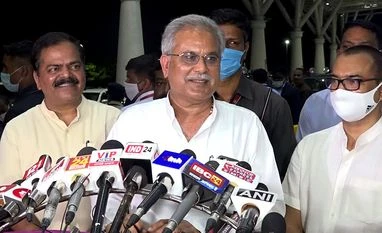
All eyes were glued to the television screen as Chief Minister Bhupesh Baghel (pictured) started his speech after inaugurating the Rashtriya Ramayana Mahotsav (National Ramayana Festival) in Raigarh, known as the industrial hub of Chhattisgarh. The three-day event was organised for the first time in the state, which figures prominently in the Ramayana.
Baghel started by saying: “Bhagwan Ram sabke hai. Nishadraj ke hai aur Shabri ke hai (Lord Ram belongs to everyone, including Nishadraj and Shabri).” It did not take much time for the BJP leaders to connect the dots; it was another volley lobbed by the Congress chief minister to hit his saffron opponents at the point where it hurt.
A political analyst said: “It is not significant to say that Lord Ram belongs to everyone. But the subtext is that Lord Ram does not belong only to the BJP or the saffron camp.”
This is a matter of concern for the BJP, the analyst added.
The Ramayana Mahotsav, from June 1 to 3, was another move by Baghel to establish that Lord Ram is dear to him and his government more than it is to the BJP. And the 15-year rule of the BJP, led by Raman Singh, powers Baghel’s cause. Nationally acclaimed artists from different parts of the country were invited to the Ramayana Mahotsav. Artists from Indonesia and Cambodia were invited and they enthralled the audience with their performance related to the epic.
The Baghel government has taken up projects related to Lord Ram that the BJP government had put under the cold carpet. The first phase of the ambitious Ram Van Gaman Tourism Circuit started in October 2021 in Chandkhuri, the birthplace of Mata Kaushalya. Till now, the government has identified 75 spots Lord Ram had traversed during his exile years in Chhattisgarh. Of those, nine have been marked for infrastructure development, restoration, and beautification.
The places include the temple of Mata Kaushalya in Chandkhuri, hardly 20 km from the state capital. Baghel has renovated and beautified the temple premises, the only one dedicated to Lord Ram’s mother in the world.
The state government has started celebrating “Mata Kaushalya Mahotsav” every year. The four-day event was organised in April this year.
Another political analyst says the chief minister has given a new dimension to his campaign, giving it a local touch and establishing the point that people of Chhattisgarh have a greater association with Lord Ram than others in the country. It would help in cushioning the Congress against the national campaign of the BJP on Lord Ram.
“Lord Ram is our nephew,” Baghel said, adding that Mata Kaushalya was born in Chhattisgarh and hence Lord Ram had deep roots in the region. “We know Lord Ram as Mata Kaushalya’s Ram,” he added.
In the 14-year exile, Lord Ram spent 10 years in the Chhattisgarh region (in the “Aranya Kand” of the Ramayana) and faced extreme hardships and difficulties but he never lost sight of his moral values and dignity. The time he spent in the forests played an important role in his journey to become Maryada Purushottam, Baghel said, adding that in this way, Chhattisgarh also had a part in his character building.
“The day of the people in Chhattisgarh begins with Ram and ends with Ram,” Baghel said.
The setting up of Rama Katha troops in every village and the series of mahotsavs organised in different parts of the state have further consolidated Baghel’s position.
Though BJP managers are working out a counter strategy, its leaders are playing it down. “For the Congress, Lord Ram is a political matter while Baghel is following Prime Minister Narendra Modi in organising such events,” BJP state President Arun Sao said.
The “Suraaji Gaon Yojana” (or good village governance) is another ambitious plan of the Sangh Parivar that has entered Baghel’s scheme of things. It envisages achieving four objectives through an integrated approach to the primary sector with the best use of native resources along with the benefits of the government’s modern schemes in agriculture, water resources, energy, forest, and rural development.
Under the scheme, the state government has set up about 8,500 gauthans (livestock sheds), which are providing a livelihood to villagers. It has become the focus of boosting the rural economy with a number of activities, including procuring cow-dung and urine, and adding value to them.
Interestingly, the schemes were designed by two people closely associated with the BJP and the Sangh Parivar. One was chairman of a commission in the erstwhile Raman Singh government while another had been implementing the schemes in the Congress government. Both (names withheld on request) had presented the projects before the BJP government, which did not take a call on them.