
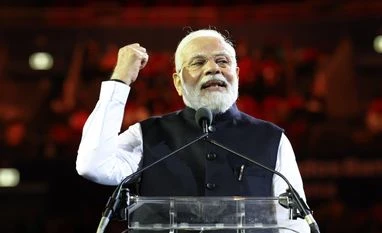
PM asks states to develop long-term vision to make India developed nation
Chief ministers of West Bengal, Punjab and Delhi boycotted the meeting
 "PM asks states to develop long-term vision to make India developed nation")
WebinarsNew
Deep DiveNew
Explore Business Standard
Chief ministers of West Bengal, Punjab and Delhi boycotted the meeting
Prime Minister Narendra Modi on Saturday asked the states and districts to develop a long-term vision to make India a developed country by 2047, when the country completes 100 years of Independence.
Addressing the eighth Governing Council meeting of NITI Aayog here, Modi also urged the states to take financially prudent decisions which are capable of delivering programmes that meet the aspirations of the people.
Briefing media about the deliberations of the meeting, NITI Aayog CEO BVR Subrahmanyam said that 11 chief ministers did not attend the Governing Council meeting.
It was also the first formal meeting at the newly-constructed Convention Centre at Pragati Maidan which later in the year will host G20 Summit.
In his address to the Governing Council, the Prime Minister said that it was essential to combine the vision of states and districts with the national vision to reach the goal of Vikasit Bharat by 2047.
"At #NITIAayog's #8thGCM, PM @narendramodi stated that when states grow, India grows. He also emphasised the importance of evolving a common vision to achieve a #VikasitBharat @ 2047," NITI Aayog said in a series of tweets.
The prime minister also urged the states to take financially prudent decisions which would make them fiscally strong and capable of undertaking programmes for the welfare of citizens.
"PM @narendramodi urged States to take financially prudent decisions so as to become fiscally strong and capable of delivering programmes that meet the dreams of citizens," the Aayog said in another tweet.
NITI Aayog's eighth Governing Council meeting deliberated on several issues including, health, skill development, women empowerment and infrastructure development, with an aim to make India a developed nation by 2047.
Prime Minister Narendra Modi chaired the meeting.
Union ministers Amit Shah, Niramala Sitharaman and Piyush Goyal and chief ministers of Uttar Pradesh, Assam, Jharkhand, and Madhya Pradesh, among others, attended the meeting.
Chief ministers of West Bengal, Punjab and Delhi boycotted the meeting. In all 11 chief ministers did not attend the meeting for different reasons.
AAP supremo and Delhi Chief Minister Arvind Kejriwal wrote to Prime Minister Narendra Modi on Friday, and announced boycotting the NITI Aayog meeting over the Centre's recent ordinance and charged that "cooperative federalism" in the country was being turned into a "joke".
The Chief Minister of the AAP-ruled Punjab, Bhagawant Mann, had also declared to boycott the Niti Aayog meeting.
West Bengal Chief Minister Mamata Banerjee in 2019 skipped the Niti Aayog meeting, saying that the think-tank had no power and the meetings were "fruitless".
Generally, the full council meeting happens every year and last year, it was held under the chairmanship of Modi on August 7. The council meeting was not convened in 2020 due to the coronavirus pandemic.
The first meeting of the council took place on February 8, 2015.
(Only the headline and picture of this report may have been reworked by the Business Standard staff; the rest of the content is auto-generated from a syndicated feed.)
First Published: May 27 2023 | 8:02 PM IST


