The two-day BS Manthan summit kicked off on February 27 in Delhi and brought together industry experts to discuss the growing role of private investment in shaping India’s defence sector. In a conversation with AK Bhattacharya of Business Standard, key figures shared insights on the evolving landscape of defence manufacturing and research.
Defence manufacturing and 'Make in India'
Rajinder Singh Bhatia, Chairman, Defence Business, Kalyani Group, and President, Society of Indian Defence Manufacturers (SIDM), recalled a meeting with Prime Minister
Narendra Modi in 2014, where he said the clarion call of ‘Make in India’ was made.
Bhatia noted that if India is to be 'Viksit Bharat' and occupy its rightful place in the committee of top nations, it cannot be a net importer of security. "This means we need to be self-reliant," he said.
Admiral (retd) R Hari Kumar, former Chief of Naval Staff, also reiterated the Navy’s focus on atmanirbharta in defence.
“We need to harness all the capabilities available in the country, including the private sector. The Indian Navy has committed to becoming a fully indigenous force by 2047. The construction of INS Vikrant by Cochin Shipyard is a testament to this commitment, involving nearly 500 MSMEs. Such projects create a multiplier effect, benefiting the economy and generating employment.”
Admiral Kumar highlighted that there was a little friction between the private and defence establishment 5-6 years ago, but that has changed now. "Today, private industry is welcomed as an essential partner in defence manufacturing," he said.
Role of SMEs
Samir Kamat, Secretary, Department of Defence R&D, Ministry of Defence, and Chairman, DRDO, stressed the necessity of private sector participation in research and development (R&D).
“Private sector involvement in both production and R&D is absolutely essential for India to become Atmanirbhar and a global technology leader, as envisioned by our Prime Minister. The private sector is more dynamic than government organisations, offering greater flexibility in hiring top talent. Startups and MSMEs play a crucial role in disruptive technologies, an area where government entities often struggle to adapt quickly," Kamat said.
Kamat said that the participation of the private sector is growing, and in the coming years, it is expected to play an equal role alongside public sector enterprises in both defence production and R&D.
However, Admiral Kumar also raised concerns about funding for SMEs engaged in defence innovation.
“While iDEX provides some funding for prototyping, it is often inadequate. SMEs have approached us regarding the need for specialised banking support. Recognising this, the Indian Navy proposed the establishment of a dedicated defence bank. Although a new bank was not created, the Finance Minister intervened in December 2023, directing SIDBI to facilitate loans for SMEs. As a result, reforms have been introduced in the budget to support private sector participation in defence."
Defence manufacturing and job creation
According to Bhatia, India is a young nation with 400 million people seeking employment, and the manufacturing industry has the highest multiplier effect in job creation.
"To build a vibrant military-industrial complex or defence industrial base, private sector participation is crucial. You can’t win a match if half your team is sitting out," Bhatia said.
Defence procurement
Bhatia also highlighted the transformation of India’s defence procurement policies. “A key challenge is the level playing field. A Defence Public Sector Undertaking (DPSU) representative might argue that private industry enjoys greater preference. However, we still need more equitable policies, fewer nominations, and better payment terms. Foreign vendors receive payments through a line of credit, while private domestic firms must go through the CTA process, which can take up to six months. Cutting down acquisition timelines is essential because if the acquisition cycle is longer than the technology development cycle, we end up procuring obsolete technology,” he said.
Addressing bureaucratic hurdles in defence procurement, Admiral Kumar emphasised the urgency of reforms. “Defence procurement policies must be simplified. Often, interdepartmental conflicts within the services and bureaucratic hurdles lead to unnecessary delays. Additionally, when drafting policies, we must consider their long-term impact. As the Honourable Prime Minister has emphasised, policies must be reviewed periodically and amended if they no longer serve their intended purpose. Decision-making must be agile, ensuring that India stays ahead in defence innovation.”

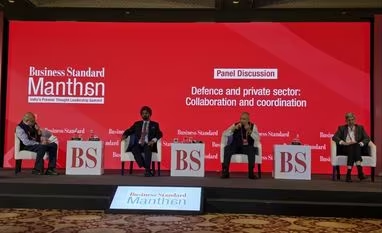 "How can pvt investment shape India's defence? Experts debate at BS Manthan")


 Connect with us on WhatsApp