By Emma Goldberg and Benjamin Oreskes
In Bedford-Stuyvesant, a 29-year-old welcomed new canvassing friends to his birthday gathering. In Flatbush, a 27-year-old fresh off a breakup gained a whole new social group. And in the East Village, a 24-year-old landed a date with another democratic socialist.
Addicted to their screens, strapped for cash, spiritually unmoored and socially stunted by the pandemic — young New Yorkers needed a reason to get out of the house. They found it in Zohran Mamdani’s mayoral run.
Volunteering for Mr. Mamdani’s campaign became a salve for members of a generation diagnosed by thought leaders with anxiety and by the surgeon general with loneliness, whose religious affiliation is often unaffiliated and who also apparently killed drinking and having sex.
“It’s honestly what I would prescribe for the loneliness epidemic,” said Tal Frieden, 28, at a rally in Sunset Park the Sunday before Election Day.
Mr. Mamdani’s campaign wasn’t just about mobilising, but socialising. And the social buoyancy of his campaign wasn’t just for show. Young people turned up and voted. The city’s roughly two-week stretch of early voting, which ended on Sunday, saw more than 735,000 residents cast ballots. The median age of these voters was 50, brought down by nearly 100,000 voters under the age of 35 showing up between Friday and Sunday.
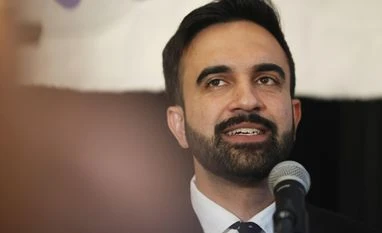
The political strategy could result in one of the most surprising electoral wins in New York City history, potentially handing a 34-year-old democratic socialist the keys to City Hall.
Mr. Mamdani’s campaign did not want volunteering for him to feel like work, but like a chance to meet new people and discover new corners of New York. His vision of the city, the campaign said, is of a joyful place — one where New Yorkers can spend less time slogging and more time hanging.
“That same spirit has animated our campaign,” said Dora Pekec, a spokeswoman.
That vision and the strategy began about a year ago, when Mr. Mamdani slid onto the social media feeds of Gen Z New Yorkers. He jubilantly crisscrossed boroughs, hitting beaches, road races and food stalls in a way that made people want to join in. He talked nonstop about the cost of living in a city where $18 cocktail menus and no-longer-one-dollar pizza slices are unsustainable on an entry-level job salary. He shared his pro-Palestinian views with supporters, who were confronted with videos of the deaths and destruction in Gaza.
And Mr. Mamdani did something else that they weren’t expecting. He invited them to come out — to a scavenger hunt (with a prize of sour-cream-and-onion potato chips, a sly reference to a Mayor Eric Adams campaign controversy), to a soccer tournament, to do-it-yourself merch nights, to a social for shredding personal documents, to bars where people could drink $5 Miller High Lifes and debrief after door knocking.
In a city of crowded apartments, of “Hey, I’m walking here,” of sweaty, squeezy subway cars, of bodegas jammed with midnight snackers, being a 20-something with no Sunday morning plans can sting a little more. Through Mr. Mamdani’s campaign, young voters found new friends.
Graciela Blandon, 24, went to a board game night for supporters of Mr. Mamdani, an arts and crafts event and even a Valentine’s Day singles gathering for his supporters (where she landed a date with the democratic socialist).
“The people I go to dinner with, the folks I go to concerts with — my day to day is organized around Mamdani,” said Ms. Blandon, who moved to New York in 2019 for college and quickly found herself holed up because of the pandemic.
Political success often comes from giving people a reason to gather. When President Trump was running last year, his rallies resembled church services, ending with reflective music hushing the crowd and palms raised in prayer. Mr. Mamdani’s campaign events are like salsa sessions at Bronx Brewery, raves at Elsewhere in Bushwick, Brooklyn, and night markets in Corona Park, Queens.
In more than a dozen interviews, Mr. Mamdani’s supporters said that coming out of the pandemic they felt adrift. This mirrors the experience of 20- and 30-somethings across the country, some of whom found their own community in conservative political spaces. Many tuned in to political influencers like Charlie Kirk, Alex Clark or Allie Beth Stuckey, who told them not just how to vote but also how to live their lives, when to get married, how to pray and what to eat. In New York, Mr. Mamdani’s supporters similarly found that the political could be personal.
“It’s this whole new social circle, and it doesn’t feel dorky,” said Lex Rountree, 27, a tenant organizer who went to a rally in Sunset Park two days before the election, and celebrated her birthday this year with a canvass.
After a breakup, organizing for Mr. Mamdani brought back Ms. Rountree’s confidence. Her friends sent one another memes joking about being at the club at 2 a.m. and getting a text from a canvass captain.
“It feels like we’re the cool kids,” she said.
At that point, Ms. Rountree spotted another friend she had bonded with while campaigning. “Hi diva!” she called. “This is a diva summit.”
Making his pitch to young voters, Mr. Mamdani found a generational foil in former Gov. Andrew M. Cuomo, who lost in the primary and is now running as an independent.
Critics of Mr. Mamdani’s campaign pointed to his inexperience as disqualifying. But for many young voters, it was Mr. Cuomo’s long record that was objectionable. They pointed to the 13 women who had accused him of sexual misconduct. (He has denied the allegations.) They rebuked his support for Israel. Then there were his policy prescriptions, which lacked urgency and felt mealy to many, anti-meme-able and impossible to distill and repeat.
Many young voters were drawn to Mr. Mamdani’s campaign for the sense of possibility — the same freshness that Barack Obama’s supporters found in the “Hope” messaging of 2008. They also shared a frustration with the establishment, as was the case years ago for those who lost faith in Mr. Obama and pinned their hopes on Senator Bernie Sanders, who has in turn lent support to Mr. Mamdani.
Mr. Adams, in his swan song to the city, has painted Mr. Mamdani’s support base as being made up of yuppie white transplants whose political identities were forged on elite college campuses. These people, Mr. Adams said, “have taken over our community.”
“He’s the king of the gentrifiers,” Mr. Adams said of Mr. Mamdani.
But some of Mr. Mamdani’s supporters, across income levels, said they shared the sense of economic uncertainty they were discussing with voters. Campaigning also brought them out of their socioeconomic bubbles.
Dave Taylor, 33, lives alone in Park Slope and works a remote job in music management — which means he spends days on Microsoft Teams, staring down digital avatars. He had always been bothered by the lack of eye contact among New Yorkers on the street. Canvassing, though, gave him an excuse to talk to strangers. The night before the election, Mr. Taylor went to Union Pool in Williamsburg with other volunteers.
“By the end of the night, people seemed like best friends,” he said. “I was like, ‘Did you guys know each other before?’”

 "A little noted element propelled Zohran Mamdani's rise: Gen Z loneliness")

