
After elephants, monkeys found to call each other by 'name' in new study
The team found that these monkeys used their phee-calls to address specific individuals
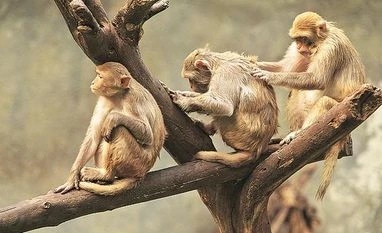 "After elephants, monkeys found to call each other by 'name' in new study")
WebinarsNew
Deep DiveNew
Explore Business Standard
The team found that these monkeys used their phee-calls to address specific individuals
After elephants, now monkeys have been found to make specific sounds to name each other, according to a new study.
Researchers found that marmoset monkeys, native to South America, use specific vocal calls, called "phee-calls", to identify and communicate with each other.
A study published in the journal Nature Ecology and Evolution in June showed that wild African elephants addressed each other with name-like calls, uniquely invented for each individual. Calls meant for other elephants did get responded to.
In this study, published in the journal Science, the researchers from the Hebrew University of Jerusalem, Israel, recorded natural conversations between pairs of marmosets, as well as interactions between monkeys and a computer system.
The team found that these monkeys used their "phee-calls" to address specific individuals.
"They (the monkeys) also perceived and responded correctly to calls that were specifically directed at them," the authors wrote.
They said that naming of others is a highly advanced cognitive ability observed in social animals and, until recently, was known to exist only in humans, dolphins, and elephants.
The discovery suggests that the marmosets' ability to vocally label each other may provide valuable insights into the evolution of human language, the researchers said.
"Marmosets live in small monogamous family groups and take care of their young together, much like humans do. These similarities suggest that they faced comparable evolutionary social challenges to our early pre-linguistic ancestors, which might have led them to develop similar communicating methods," lead researcher David Omer from the Hebrew University of Jerusalem said.
The researchers also revealed that family members within a marmoset group use similar vocal labels to address different individuals and employ similar sound features to code different names -- similar to the use of names and dialects in humans.
This learning appears to occur even among adult marmosets not related by blood, suggesting that they learn both vocal labels and dialect from other members of their family group, the team said.
The authors believe that this vocal labelling may have evolved to help marmosets stay connected in their dense rainforest habitat, where visibility is often limited.
By using these calls, they can maintain their social bonds and keep the group cohesive, the team said.
(Only the headline and picture of this report may have been reworked by the Business Standard staff; the rest of the content is auto-generated from a syndicated feed.)
First Published: Aug 31 2024 | 2:50 PM IST


 Connect with us on WhatsApp