Bangladesh voted on Thursday in a general election held after months of political uncertainty, with ballots cast to form a new parliament and decide on a reform package through a national referendum. The vote aims to replace the interim administration led by Muhammad Yunus, which assumed charge after the fall of Sheikh Hasina’s Awami League government in August 2024.
Results for the elections are expected on Friday morning, following which the government formation process will begin, depending on the outcome.
The 13th parliamentary election took place alongside a referendum on the proposed “July National Charter 2025”, an 84-point reform agenda prepared following consultations among political parties and the National Consensus Commission headed by Yunus.
The Awami League, however, has been barred from participating in the current contest.
A total of 2,034 candidates from 51 parties are contesting the polls. Major parties include the Bangladesh Nationalist Party (BNP), Jamaat-e-Islami (JeI), the student-led National Citizen Party (NCP) formed after the uprising, and other regional parties.
How did turnout and polling proceed?
Voting took place from 7:30 am to 4:30 pm local time across the country. According to reports, officials allowed voters who had entered polling premises before closing to cast their ballots.
According to figures cited by The Daily Star, voter turnout across 36,031 polling stations had reached 47.91 per cent as of 2:00 pm. In total, 42,651 polling centres were set up for the election.
Voters received two ballots: a white ballot for parliamentary candidates and a pink ballot for the referendum. The referendum ballot required a "Yes/No" response to proposals for four major reform areas of the July Charter.
How is the vote count being conducted?
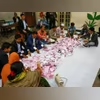
Following the close of voting, ballot boxes were sealed and moved to counting rooms within polling centres. Counting has begun in the presence of election officials, candidate agents, and observers where permitted, an Al Jazeera report said.
Election staff first separated the two ballots before counting them independently. Invalid ballots, including those that were torn or improperly marked, were set aside. Results from each centre were recorded on official forms and displayed publicly before being sent under security to constituency-level returning officers, as per the report.
Returning officers are responsible for compiling results from all polling centres within a constituency, including postal ballots, and submitting them to the Election Commission’s central system. National updates are being aggregated at the commission’s headquarters in Dhaka, news agency Reuters reported.
According to reports, officials indicated that counting both parliamentary and referendum ballots could extend the timeline beyond previous elections. Preliminary results from individual centres are expected to emerge through the evening, while a clearer national picture is likely to take shape overnight. Most results may be compiled by Friday morning.
Candidates can seek recounts from the Election Commission or challenge outcomes before an election tribunal if disputes arise, The Daily Star said in a report.
How did leaders react to the voting?
Muhammad Yunus, chief adviser to the interim government, described the vote as orderly and urged parties to maintain restraint after the results.
“The spontaneous participation of voters, the responsible behaviour of political parties, the restraint of candidates, and the professionalism of all election-related institutions have proven that our commitment to democracy is unwavering,” he said in a statement.
He also called on political actors to maintain democratic conduct once final results are announced.
BNP leader Tarique Rahman, who returned to Bangladesh last year following a 17-year exile in the UK due to ongoing investigations against him in his home country, said his party would accept the outcome if the process is fair. “If the election is free, if it is fair, if it is without controversy, then why would we not accept it? Of course, we will accept it,” he was quoted as saying by Al Jazeera. He further said that the polls must remain neutral and peaceful.
A Jamaat-backed alliance called for voting to be annulled in several constituencies, alleging irregularities and voter intimidation, according to a report by Al Jazeera.
Officials withdrew three polling personnel from a station in Gazipur after complaints of vote-rigging, The Daily Star reported. In another report, the Bangladesh newspaper said that at least four people died after falling ill near the polling stations in four districts during polling hours.
Despite these incidents, reports indicated that voting remained largely peaceful, the report said.
What are voters expecting from the next government?
A pre-election survey by the International Institute of Law and Diplomacy, based on responses from nearly 64,000 people, showed that controlling inflation was the top priority for 67 per cent of respondents. Improving law and order and tackling corruption ranked next.

 "Bangladesh holds polls, referendum after 2024 upheaval, results on Friday")


