Home / World News / Blinken meets China's VP as nations increase contact on sidelines of UNGA
Blinken meets China's VP as nations increase contact on sidelines of UNGA
The quick succession of US-China contacts is fueling speculation that President Joe Biden may meet his Chinese counterpart Xi Jinping in November at an Asia-Pacific Economic conference
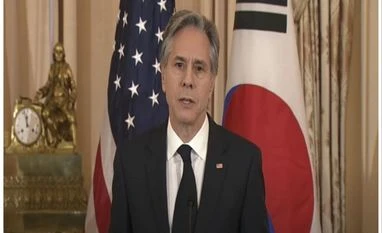
Han told Blinken that US-China relations face "difficulties and challenges" that require both countries to show "more sincerity" and make additional efforts to "meet each other half way" | Photo: ANI Twitter
Secretary of State Antony Blinken met Monday with China's vice president on the sidelines of the UN General Assembly as the Biden administration and Beijing step up high-level contacts ahead of what could be a leader-level summit this fall.
Blinken and Vice President Han Zheng held talks Monday at the Chinese mission to the United Nations. Their discussion came as China's Foreign Minister Wang Yi was in Moscow meeting Russian Foreign Minister Sergey Lavrov after wrapping up two days of talks with US national security adviser Jake Sullivan in Malta.
The quick succession of US-China contacts is fueling speculation that President Joe Biden may meet his Chinese counterpart Xi Jinping in November at an Asia-Pacific Economic conference in San Francisco.
"I think it's a good thing that we have this opportunity to build on the recent high-level engagements that our countries have had to make sure that we're maintaining open communications and demonstrate that we are responsibly managing the relationship between our two countries," Blinken said in brief remarks at the top of the meeting.
Han told Blinken that US-China relations face "difficulties and challenges" that require both countries to show "more sincerity" and make additional efforts to "meet each other half way."
Blinken visited Beijing over the summer after canceling a planned trip there in February following the shootdown of a Chinese surveillance balloon over U.S. territory. Blinken was followed to Beijing by Treasury Secretary Janet Yellen, climate envoy John Kerry and Commerce Secretary Gina Raimondo.
"From the perspective of the United States, face-to-face diplomacy is the best way to deal with areas where we disagree and also the best way to explore areas of cooperation between us," Blinken said. "The world expects us to responsibly manage our relationship. The United States is committed to doing just that."
The White House said Sunday that Sullivan's meeting with Wang in Malta was intended to "responsibly maintain the relationship" at a time of strained ties and mutual suspicion between the rival powers. It said the pair had "candid, substantive and constructive discussions."
The White House said Sullivan and Wang discussed the relationship between the two countries, global and regional security issues, Russia's war in Ukraine and the Taiwan Strait. They also discussed artificial intelligence, counternarcotic efforts and the status of detained US citizens in China.
However, after those talks, Wang travelled immediately to Russia for several days of security consultations with senior Russian officials.
China and Russia have grown closer as relations with the West have deteriorated for both. China is looking for support as it seeks to reshape the US-led international order into one that is more accommodating to its approach. Last month, it helped engineer an expansion of the BRICS partnership, which invited six more countries to join what has been a five-nation bloc that includes China and Russia.
The US and China are at odds over Russia's military action in Ukraine. China has refrained from taking sides in the conflict, saying that while a country's territory must be respected, the West needs to consider Russia's security concerns about NATO expansion. It has accused the US of prolonging the fighting by providing arms to Ukraine, weaponry that the US says Kyiv needs to fight back against Russia.
Wang's trip to Moscow also came a day after North Korean leader Kim Jong Un left Russia following a six-day visit that included talks with President Vladimir Putin at a far eastern spaceport, visits to aircraft plants and inspections of nuclear-capable strategic bombers and an advanced warship. Kim's trip fuelled Western concerns about an arms alliance that could boost Russian arsenals for fighting in Ukraine.
(Only the headline and picture of this report may have been reworked by the Business Standard staff; the rest of the content is auto-generated from a syndicated feed.)

 "Blinken meets China's VP as nations increase contact on sidelines of UNGA")


