By Catherine Thorbecke
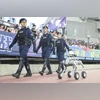
Humanoid robots have been getting a lot of buzz this year. But quadrupeds — the mechanical “dogs” — are emerging as the true proving ground for embodied artificial intelligence.
These four-legged machines have an edge over their upright cousins in stability and agility, making them better suited for real-world deployment. They are the “most advanced general-purpose robots today,” according to a report released last week from Semianalysis. China, not the US, already dominates.
Looking at the most recent publicly available statements, the analysts found that Hangzhou Unitree Technology Co. currently leads the market, capturing some 70 per cent of global sales volume for quadrupeds in 2023. The numbers have likely surged since, but even two years ago Unitree had 10 times the total shipments of its next competitor, US-based Boston Dynamics Inc.
It’s a lead that will be difficult for the US to claw back. Quadruped robots are fast evolving from backflipping tech demos to serious testbeds for computer systems navigating the real world — the same functions humanoids need to unlock to truly become commercially viable. Understanding how the four-legged market has progressed offers a preview for who might win the humanoid race, which Elon Musk is betting the future of Tesla Inc. on. Morgan Stanley forecasts that this market could surpass $5 trillion by 2050.
Beijing’s support for so-called embodied artificial intelligence has boosted the domestic robotics sector, while vast tech and electric vehicles supply chains have driven down costs and sped up development. Unitree’s rise also shows how China’s approach to open collaboration has fueled progress. Last week, Unitree announced a new education platform for students to help train its robot dogs, specifically the lower-cost Go2 model, which starts at $1,600. The move opens the Go2 ecosystem for people to learn operation and maintenance as well as research for applications. It simultaneously crowdsources valuable training data while cultivating brand loyalty and the next generation of robotics engineers. This will help move droids beyond repetitive, stationary tasks and unlock broader utility.
Boston Dynamics’ robot dog, Spot, currently offers more capabilities and was launched long before China joined the fray. But its steep price tag has kept it out of most research labs. Unitree’s affordability, by contrast, has spawned an ecosystem of developers and academics. As more labs, universities and a broader community use its hardware, it creates a virtuous cycle for the company to further capture the market.
Unitree is now preparing one of China’s most anticipated initial public offerings in years, eyeing a valuation of some $7 billion. Founder Wang Xingxing, seen front-row during President Xi Jinping’s February meeting with tech executives, said earlier this year that the annual revenue topped $140 million — and that it’s been profitable since 2020, a rare feat in a cash-burning sector.
There are still myriad hurdles for the nascent industry. Despite all the hype, especially from China, it is not yet ready for primetime. Many are still trying to prove themselves as useful, instead of just highlighting the tricks they can do. And government support risks some of these turning into no more than expensive display pieces for state-owned enterprises.
It has been easy to laugh at some of China’s public robot spectacles over the past year. There was the half-marathon, where runners tripped, fell apart and a majority didn’t complete the race. There was also a flailing kick-boxing competition, and a jerky soccer match. But dismiss these stunts at your peril.
Each experiment reveals how quickly the technology is maturing — at a scale that seemed impossible even just a few years ago. In many ways, it reflects a tech cycle that has played out in areas like autonomous vehicles, which largely disappointed before quietly scaling up. It also shows the extent of the army of engineers in China tinkering on these droids.
Despite the clumsy robot games, Beijing is already seeing its automation push reshape industries. There were more than 2 million factory robots working in China last year, the largest of any country, according to data last month from the International Federation of Robotics. The People’s Republic installed more industrial robots in 2024 (295,000 units) than the rest of the world combined — and more than eight times the installations in the US.
The implications for the global labor market are profound, and the threat is already causing consternation stateside. China, which has less protections for organized labor, is doubling down on automation as a demographic necessity. It’s a vivid illustration of writer Dan Wang’s observation that America is run by lawyers and China by engineers.
By driving down costs and winning over the research community, Unitree is quietly setting the stage to dominate across a range of applications in the new industrial age. If the global dream for humanoid robots means they have to walk on four legs before they stand on two, China’s lessons on how to train your robot dogs are critical.
(Disclaimer: This is a Bloomberg Opinion piece, and these are the personal opinions of the writer. They do not reflect the views of
www.business-standard.com or the Business Standard newspaper)


 "China leads global market as robot dogs become major AI testing ground")


