Home / World News / For the first time ever, scientists capture image of star in another galaxy
For the first time ever, scientists capture image of star in another galaxy
A huge success for astronomers as they captured an extreme close-up image of the dying star, WOH G64, which is 1,60,000 light years away from our milky way
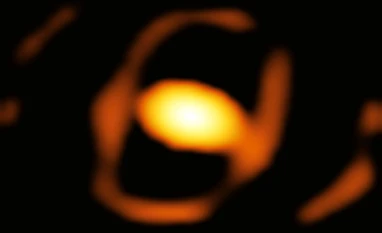
Scientists have captured a zoom-in image of a star, which is 2000 times more massive than the sun and is located 1,60,000 light-years ahead, in another galaxy. It is for the first time that astronomers have captured a “zoomed-in” image of a star outside our own Milky Way galaxy.
The close-up image of the dying star reveals some crucial details about the star's activity and its surrounding layers.
The European Southern Observatory’s Very Large Telescope Interferometer (ESO’s VLTI) captured the image of the massive star. The image shows the star emanating dust and gas indicating that it is in the last stages of becoming a supernova triggered by a powerful explosion towards the end of a star's life.
The study published in Astronomy and Astrophysics, is conducted under the leadership of Keiichi Ohnaka, an astrophysicist from Universidad Andres Bello in Chile. Talking about the success, Ohanka said, “For the first time, we have succeeded in taking a zoomed-in image of a dying star in a galaxy outside our own Milky Way.”
Ohnaka also stated that he discovered ‘an egg-shaped cocoon’ around the star. According to astronomers, the latest study is a milestone as the detailed images of the stars in the galaxy reveal their properties. This observation is a big step forward in great detail.
Ohnaka and colleagues trying to capture WOH G64 for some time
Tens of zoomed-in images of stars have been captured so far within our own Milky Way galaxy, but it’s for the first time that astronomers have managed to capture a star beyond our galaxy with such detail. Ohnaka and colleagues have been trying to capture WOH G64 for some time now and the team is studying the star with the VLTI, located in the Atacama Desert of Northern Chile, in 2005 and 2007.
This success will help to unveil further details of the behemoth star. Catching an actual image of WOH G64 had to wait till the development of a second-generation VLTI instrument called "GRAVITY." It combines light from four VLT telescopes to image faint objects with great sensitivity.
What is WOH G64?
The WOH G64 is a huge star located in the Large Magellanic Cloud, a dwarf or satellite galaxy that orbits our Milky Way. This galaxy is also closest to us and was discovered in the 1970s by Bengt Westerlunds, Olander, and Hedin. The giant star is classified as a red supergiant which is 2000 times the mass of the sun and its name, WOH, is the acronym for the names of its three discoverers.

 "For the first time ever, scientists capture image of star in another galaxy")


