
Macron's comeback: Handling crisis in France to shaping Europe's defence
Known for his nonstop political activism, Macron shifted his focus to foreign policy, leaving domestic struggles largely to the prime minister
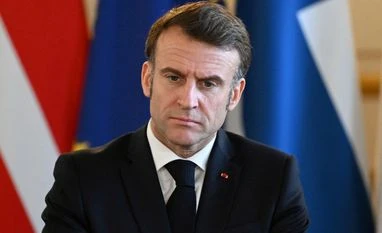 "Macron's comeback: Handling crisis in France to shaping Europe's defence")
Explore Business Standard

Associate Sponsors
Co-sponsor
Known for his nonstop political activism, Macron shifted his focus to foreign policy, leaving domestic struggles largely to the prime minister
French President Emmanuel Macron is back at the centre of global diplomacy, seeking to ease relations with President Donald Trump, championing a Ukraine peace plan alongside his British counterpart, and seeing his longstanding desire to boost European defence turning into reality.
Six months ago, Macron seemed weaker than ever after his call for early legislative elections produced a hung parliament, sparking an unprecedented crisis.
Known for his nonstop political activism, Macron shifted his focus to foreign policy, leaving domestic struggles largely to the prime minister.
Now, he appears as the one leader who speaks to Trump several times per week and takes the lead in European support for Ukraine, while positioning himself as the commander-in-chief of the European Union's only nuclear power.
Key world player Macron, 47, is one of the few leaders who knew Trump during his first term in office, maintaining despite disagreements a cordial relationship, which both describe as friendship.
He was the first European leader to visit Trump since his reelection, seeking to persuade him not to abandon Ukraine in pursuit of a peace deal with Russia.
Macron is also a heavyweight of European politics, and shifting US policies gave momentum to his longstanding views.
Since he was first elected in 2017, Macron has pushed for a stronger, more sovereign Europe. That same year, in a sweeping speech at Sorbonne University, he called for a common European defense policy, with increased military cooperation and joint defence initiatives.
He later lamented the brain death of the NATO military alliance, insisting the EU should step up and start acting as a strategic world power.
On Thursday, EU leaders committed to strengthening defences and freeing up hundreds of billions of euros for security in the wake of Trump's warnings that they might face the Russian threat alone.
Nuclear power In a resounding declaration last week, Macron announced he would discuss extending France's nuclear deterrent to European partners to help protect the continent.
France's nuclear power is inherited from the strategy set by wartime hero Gen. Charles de Gaulle, president from 1958 to 1969, who sought to maintain France's independence from the US and assert the country's role as a global power.
That went through the development of an independent French nuclear arsenal.
Poland and Baltic nations welcomed the proposal.
France's Minister for European affairs Benjamin Haddad praised Macron's efforts, saying they were aimed at ensuring that "in the face of this world upheaval, Europeans are not spectators but players.
New British and German partners Some other key players appear to back Macron's approach.
British Prime Minister Keir Starmer, in office for eight months, has sought closer defense cooperation with Europe as part of a reset with the EU after years of bitterness over Brexit.
Macron and Starmer are now spearheading a desperate diplomatic drive to bolster Ukraine's defences, drawing up a peace plan with Kyiv at its core. That plan includes the possibility of sending European troops to Ukraine to enforce a potential peace agreement.
Meanwhile, Germany's conservative election winner Friedrich Merz said his top priority would be to strengthen Europe as soon as possible and gradually move toward real independence from the US.
Only three days after his victory last month, Merz, who has called for a discussion on nuclear sharing with France, traveled to Paris for a working dinner with Macron.
No statement was released after the meeting, but French officials with knowledge of the matter said both men's visions for Europe align. They spoke anonymously because the talks were not to be made public.
Russia's criticism Russia's foreign ministry accused Macron of "demonstrative militarism dictated by the domestic agenda.
The ministry said that Macron seeks to distract the French public from worsening socio-economic problems in France and the European Union".
Moscow dismissed Macron's nuclear deterrent offer as extremely confrontational, saying the remarks reflected Paris' ambitions to become the nuclear patron' of all of Europe, despite the fact that France's nuclear forces are far smaller than those of the US.
Russian President Vladimir Putin drew a comparison with Napoleon, saying that some people want to return to the times of Napoleon, forgetting how it ended a reference to the emperor's failed invasion of Russia in 1812. Macron responded by calling Putin an imperialist.
Reinvigorated at home Reelected in 2022, Macron last year struggled not to become a lame duck after his call for early legislative elections led to a chaotic situation in parliament, delaying the approval of the state budget and forcing the quick replacement of the prime minister.
However, the French Constitution grants the president some substantial powers over foreign policy, European affairs and defense. Macron has a presidential mandate until 2027 and he has said he won't step down before the end of his term.
Macron's activism on the global stage drew criticism from opposition leaders.
Far-right National Rally party vice president Sbastien Chenu described Macron's moody character as one of the biggest issues for French diplomacy. "He offended many people, he often changed his mind, Chenu said.
The head of the hard-left France Unbowed group at the National Assembly, Mathilde Panot, also voiced concerns.
The situation is too serious and the President of the Republic is too weakened for him to decide on his own," she said. "We don't just want to be consulted. ... It's up to the parliament to decide on such serious issues.
(Only the headline and picture of this report may have been reworked by the Business Standard staff; the rest of the content is auto-generated from a syndicated feed.)
First Published: Mar 09 2025 | 1:45 PM IST

