Starship's latest flight ends in a crash, but it's still a win for SpaceX
SpaceX's Starship disintegrated over the Indian Ocean during its ninth test flight as the first-stage Super Heavy booster exploded instead of executing a soft splashdown in the Gulf of Mexico
Rimjhim Singh New Delhi SpaceX’s Starship — the towering rocket that is central to Elon Musk’s dream of interplanetary travel — flew farther than ever before in its latest test, only to end in a crash over the Indian Ocean on Tuesday evening (local time). The fourth integrated test flight of the two-stage spacecraft marked a step forward, despite falling short of mission objectives.
The 403-ft (123-metre)
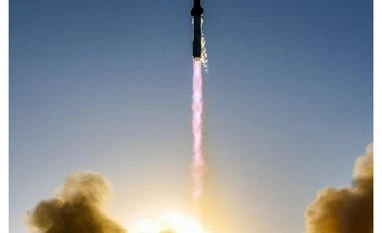
Starship lifted off from SpaceX’s Starbase facility near Brownsville, Texas, around 6:36 pm local time. A live webcast showed the rocket rising amid plumes of exhaust and vapour, making it past earlier failure points. But soon after separation, the first-stage Super Heavy booster exploded instead of executing a soft splashdown in the Gulf of Mexico, according to news agency Reuters.
The upper stage continued on its planned suborbital path, but problems mounted. About nine minutes into the flight, Starship’s payload doors failed to open, preventing deployment of eight Starlink simulator payloads. SpaceX later confirmed that the vehicle lost attitude control and began spinning during its return journey.
“Starship experienced a rapid unscheduled disassembly,”
SpaceX posted on X.
The onboard cameras went dark roughly 45 minutes into what was supposed to be a 66-minute flight. The flight fell short of its target splashdown zone off the west coast of Australia.
Despite the crash, the test was a success: Starship flew farther and lasted longer than during its previous two attempts. Elon Musk remained upbeat, promising to increase the pace of testing. “Launch cadence for the next 3 flights will be faster — approximately one every 3 to 4 weeks,” he posted on X.
Deliberate crash of super heavy booster
Unlike the upper stage mishap, the Super Heavy booster’s crash into the Gulf of Mexico was part of a planned experiment. This ninth integrated test flight included the first-ever reflight of a Super Heavy booster, previously used during the seventh flight and retrofitted with upgraded hardware and engines.
After stage separation, the booster executed a controlled flip, a boostback burn, and a high-angle descent. Instead of attempting a precision landing or being caught by the ‘Mechazilla’ robotic tower, SpaceX deliberately opted for a hard splashdown to gather data on structural resilience and landing systems.
The final descent used backup engines in a new configuration to simulate challenging landing scenarios.
Key successes of the mission:
* Starship flew farther and lasted longer compared to its previous two attempts.
* First-ever reflight of a Super Heavy booster was successfully conducted with upgraded hardware and engines.
* Super Heavy booster executed a controlled flip, boostback burn, and high-angle descent as planned.
* Deliberate hard splashdown of the booster gathered valuable data on structural resilience and landing systems.
* The mission advanced Starship’s role in future interplanetary travel and Nasa’s Artemis 3 lunar mission plans.
High stakes of the mission
Starship is the largest and most powerful launch vehicle ever constructed and a centerpiece of Musk’s Mars colonisation plan. It is also crucial to
Nasa’s Artemis 3 mission, which will use a variant of the spacecraft to land astronauts on the Moon.
The US Federal Aviation Administration recently approved a ramp-up of Starship launches from five to 25 annually, dismissing environmental objections from conservation groups concerned about sea turtles and shorebirds.
Despite three partial failures this year, each test flight has provided critical insights for the Starship programme. Musk and his team remain committed to their “fail fast, learn fast” approach — a strategy that has already helped SpaceX dominate the commercial launch industry.

 "Starship's latest flight ends in a crash, but it's still a win for SpaceX")


 Connect with us on WhatsApp