
Sunita Williams breaks into gig onbard ISS after arrival on Boeing capsule
The journey wasn't without challenges, as new issues arose en route, but NASA astronauts Wilmore and Williams safely arrived aboard the station after overcoming obstacles
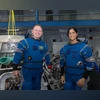 "Sunita Williams breaks into gig onbard ISS after arrival on Boeing capsule")
WebinarsNew
Deep DiveNew
Explore Business Standard
The journey wasn't without challenges, as new issues arose en route, but NASA astronauts Wilmore and Williams safely arrived aboard the station after overcoming obstacles
Indian-origin Sunita Williams and Butch Wilmore on Friday morning entered the International Space Station, the US space agency said on Friday.
NASA's Boeing Starliner carrying the two astronauts had docked with the ISS at 1:34 pm (EDT) after lifting off from the Cape Canaveral Space Force Station in Florida on Wednesday.
Footage from NASA showed the two NASA astronauts entering through the hatch door of the USS at 3:46 pm ET on Thursday (which translates to IST on Friday morning). The seven astronauts of the Expedition 71 crew on the ISS greeted Sunita and Butch, the first astronauts to fly on Boeing's new capsule.
The 59-year-old Indian origin astronaut broke into a gig after entering through the hatch into the ISS and hugged the astronoauts onboard the space station.
The spacecraft launched on a United Launch Alliance Atlas V rocket at 10:52 am June 5 (local time) from Space Launch Complex-41 at Cape Canaveral Space Force Station in
The journey wasn't without challenges, as new issues arose en route, but NASA astronauts Wilmore and Williams safely arrived aboard the station after overcoming obstacles.
The docking occurred with additional steps taken to secure the connection between Starliner and the station's port. Wilmore expressed his delight, stating, "Nice to be attached to the big city in the sky."
Pressure was equalized between Starliner and the ISS, and the hatch between the two opened at about 3:46 pm ET, with the crew warmly welcomed by their ISS counterparts.
"We had music. Matt was dancing. It was great. What a wonderful place to be back," Willmore remarked, expressing gratitude to those involved in the mission.
Williams echoed his sentiments, expressing thanks to family and friends and delight at being part of the ISS family.
"We have another family up here, which is just awesome," Williams said. "And we're just happy as can be to be up in space, one in Starliner on an Atlas V, and then here at the International Space Station. It just doesn't get much better."
The Expedition 71 crew of NASA astronauts on board the ISS include Michael Barratt, Matt Dominick, Tracy C. Dyson, and Jeanette Epps, and Roscosmos cosmonauts Nikolai Chub, Alexander Grebenkin, and Oleg Kononenko.
Jim Free, NASA Associate Administrator, hailed the mission's significance during a news conference, emphasising its role in advancing human spaceflight.
"The launch yesterday and docking today puts the Starliner on a path to certification to enabling continued exploration and science that benefits humanity," Free said during a news conference Thursday.
"For Butch and Suni, I want to thank them for the years they have spent to getting us to this point, the expertise they bring to their roles and their dedication to the task of advancing human spaceflight," he added.
The duo will spend the next eight days on the orbiting laboratory, as reported by CNN.
Despite challenges during the journey, including helium leaks and thruster issues, the mission proceeded, with the crew successfully troubleshooting and rectifying problems as they arose.
Boeing aerospace engineer Jim May confirmed the stability of Starliner despite helium leaks, stating it wasn't a safety concern. Mission control closely monitored the situation while the crew proceeded with docking.
Steve Stich, NASA's Commercial Crew Program manager, likened the challenges faced by Starliner to those encountered by previous spacecraft programs, stressing their manageable nature.
According to the space agency two additional helium leaks were detected on the vehicle. One helium leak had been discovered prior to launch and deemed acceptable.
"Helium is used in spacecraft thruster systems to allow the thrusters to fire and is not combustible or toxic," Boeing said in a post on X.
As of Thursday morning, two of the three leaks have been corrected, according to a live NASA broadcast. A fourth minor leak was discovered later as well, Stich said.
Mission managers polled "go" for rendezvous and docking with the space station, and the leaks were not expected to impact docking, according to the broadcast.
"During all of Starliner's rendezvous and proximity operations, we'll keep those propellant manifolds open, but they'll stay open until docking. Starliner's currently maintaining plenty of helium reserves," Boeing aerospace engineer Jim May confirmed Thursday morning in a social media post on X shared by Boeing.
"Currently the helium leak is not a safety issue for the crew, the vehicle or the mission."
"What we need to do over the next few days is take a look at the leak rate there and figure out what we go do relative to the rest of the mission," he said. "I think we have some tools in our toolkit to manage this. We'll take a little time to go, assess it and we'll undock and land when we're ready."
"Now that we're in flight and we've seen a couple more leaks, if it is a common cause across those flanges, then there might be something more to the flange itself, maybe a bad lot of seals or some other variable," he said.
Stich said the problems Starliner is facing is not unlike the first crewed flight of NASA's Space Shuttle Program, or other test flights of spacecraft rated to take humans to space.
Just as Wilmore and Williams were about to go to sleep Wednesday night, mission control informed them that they needed to shut down two valves due to the new helium leaks, CNN reported.
"Teams have identified three helium leaks on the spacecraft. One of these was previously discussed before flight along with a management plan," NASA shared in the post. "The other two are new since the spacecraft arrived on orbit. Two of the affected helium valves have been closed and the spacecraft remains stable."
Starliner's highly anticipated journey, a culmination of Boeing's efforts under NASA's Commercial Crew Program, represents a significant milestone in US spaceflight history.
The mission's success heralds a new era in space exploration and collaboration between NASA and private industry partners, with Williams making history as the first woman aboard such a mission.
Despite delays and setbacks in previous launch attempts, the successful arrival of Starliner at the ISS underscores the resilience and perseverance of the teams involved, CNN reported.
(Only the headline and picture of this report may have been reworked by the Business Standard staff; the rest of the content is auto-generated from a syndicated feed.)
First Published: Jun 07 2024 | 10:46 AM IST

