Home / World News / UK PM Starmer under pressure as chief of staff quits over Mandelson row
UK PM Starmer under pressure as chief of staff quits over Mandelson row
Starmer's vulnerability was laid bare in the wake of McSweeney's departure, when two key Labour-linked groups suggested accountability shouldn't end with the chief of staff
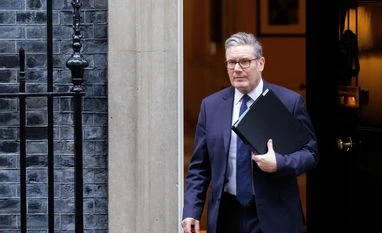
His departure leaves the prime minister with his inner circle much diminished at a time when dismal poll ratings have members of the party casting around for a successor | Image: Bloomberg
Keir Starmer’s Chief of Staff Morgan McSweeney quit his post on Sunday, becoming the casualty of a furor over the decision to appoint Peter Mandelson as the UK’s ambassador to Washington that now threatens the prime minister’s own position.
The loss of his key aide is a hammer blow to Starmer, who as recently as Wednesday said he retained confidence in McSweeney and considered him an “essential part of my team.” With the Irishman the architect of Labour’s 2024 election landslide win and the prime minister’s closest senior adviser, his departure leaves the prime minister exposed at a time when frustrated members of parliament are braying for change at the top.
Starmer’s vulnerability was laid bare in the wake of McSweeney’s departure, when two key Labour-linked groups suggested accountability shouldn’t end with the chief of staff.
Mainstream, a network of Labour politicians from the left of the party, issued a statement saying: “All those involved in the disastrous appointment of Peter Mandelson as ambassador to the US must be held to account.” Compass, another left-wing pressure group, was blunter, saying in a statement: “in time, a new captain will be needed to steer the party.”
Opposition parties also wasted no time in turning the focus on Starmer. “The buck stops with him,” said Deputy Leader of the Liberal Democrats Daisy Cooper in a statement, while main opposition Conservative Party Leader Kemi Badenoch said on X that Starmer should “take responsibility for his own terrible decisions.” Nigel Farage, the populist leader of the poll-leading Reform UK Party, predicted that the premier “won’t be far behind” McSweeney.
McSweeney’s exit and the renewed speculation over Starmer’s position will likely be the focus of gilt traders on Monday morning. Investors have in the past reacted negatively to the prospects of Starmer or Chancellor of the Exchequer Rachel Reeves leaving their posts, out of concern they could be replaced by colleagues less committed to fiscal rigor.
Even before McSweeney quit, cabinet minister Pat McFadden gave a round of morning interviews on Sunday highlighting the economic risks associated with unseating the premier.
“It’s not good for the country to change his prime minister every 18 months or two years,” he told Sky News. “It’s leading to chaos and uncertainty economically, politically and reputationally around the world.”
It’s a sign of the turmoil besetting Labour that McSweeney is Starmer’s second chief of staff to leave in just 19 months, having initially been appointed to a different position in the administration following the 2024 election victory he masterminded. A person familiar with the matter said Jill Cuthbertson and Vidhya Alakeson will replace McSweeney as joint chiefs of staff immediately, having previously served as his deputies.
His departure leaves the prime minister with his inner circle much diminished at a time when dismal poll ratings have members of the party casting around for a successor, with Health Secretary Wes Streeting and former Deputy Prime Minister Angela Rayner touted as contenders.
“The decision to appoint Peter Mandelson was wrong: he has damaged our party, our country and trust in politics itself,” McSweeney said on Sunday in a statement. “I advised the prime minister to make that appointment and I take full responsibility for that advice.”
Starmer said in a statement of McSweeney: “He turned our party around after one of its worst ever defeats and played a central role running our election campaign,” adding “it is largely thanks to his dedication, loyalty and leadership that we won a landslide majority and have the chance to change the country.”
The latest ructions within Labour were sparked by revelations over the past 10 days that Mandelson appeared to have leaked sensitive government information to the convicted pedophile Jeffrey Epstein while serving as a minister in the last Labour administration under then premier Gordon Brown.
That put fresh scrutiny on Starmer’s judgment in appointing someone who’d twice resigned from government in controversial circumstances and was nicknamed the Prince of Darkness because of his mastery of political manipulation.
On Wednesday the prime minister acknowledged he’d known Mandelson maintained ties with Epstein for years after the financier’s 2008 conviction in a state prostitution case involving a minor, but said he’d been deceived about the nature of the relationship.
On Thursday, he publicly apologized for “having believed Mandelson’s lies” and appointed him in the first place. McSweeney was instrumental in advancing the former Labour politician for the role.
Starmer sacked Mandelson as envoy in September hours after Bloomberg detailed previously unreported emails between him and Epstein that cast new light on their relationship. The US Department of Justice then released a fresh trove of emails late last month, providing further details how close Mandelson had been to the financier.
The scale of alarm within Labour became apparent immediately after Starmer’s appearance in the Commons on Wednesday when the opposition Conservatives used an arcane Parliamentary procedure to try to force the government to publish the material involved in Mandelson’s vetting.
The government sought to insert caveats allowing it to withhold material on national security grounds, but a succession of Labour MPs — including Rayner — made it clear they thought that ministers should hand the ability to make that determination to Parliament’s cross-party Intelligence and Security Committee.
Ultimately the government backed down and agreed to take that course, although the Metropolitan Police has said there may be limits to what can be shared while it pursues a criminal inquiry into Mandelson’s conduct.
None of those papers have yet been published, and with McSweeney out Starmer is now unshielded in the event of further revelations.
The prime minister will hope that his aide’s departure dims the clamor from his Labour Party critics. But, amid record-low personal ratings and dire polling for his party, he was already girding for imminent electoral challenges that may prove existential.
The first comes in the form of a Feb. 26 special election in Gordon and Denton which ought to be a Labour stronghold. In May there’s a much wider set of local elections in which Labour is expected to suffer steep losses. Starmer must now confront those challenges without the help of the man who devised Labour’s success in 2024 — provided he is still leading his party when the tests arrive.

 "UK PM Starmer under pressure as chief of staff quits over Mandelson row")


