A series of errors involving risky flying maneuvers, ignored warnings, and critical communication failures led to the mid-air
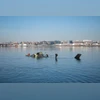
collision between a Black Hawk helicopter and an American Airlines flight over the Potomac River near Washington, DC, killing 67 people, according to a The New York Times report. The crash, which occurred on January 29, 2025, is now considered one of the worst domestic aviation disasters in the United States in nearly 25 years.
Flying too high and ignored warning
At the time of the crash, the Black Hawk helicopter was flying at 278 ft — significantly above its permissible limit of 200 ft — while the American Airlines jet was descending at 313 ft towards runway 33 at Ronald Reagan Washington National Airport. The two aircraft collided at approximately 300 feet altitude around 8.48 pm (local time).
ALSO READ: Black Hawk crash: Why was Rebecca Lobach's name kept secret for so long? “Not only was the Black Hawk flying too high, but in the final seconds before the crash, its pilot failed to heed a directive from her co-pilot, an Army flight instructor, to change course,” reported The New York Times.
The report said that Captain Rebecca Lobach, piloting the Black Hawk, ignored her co-pilot Andrew Eaves’s call to turn left just 15 seconds before the collision.
Equipment limitations
Some crucial instructions from the control tower were ‘stepped on’ — interrupted by other transmissions — meaning the helicopter crew likely missed critical messages, The New York Times report mentioned.
“You hear a command from air traffic control, and you repeat it back to clarify that you have indeed heard it," explained aviation expert Dan Ronan to 7News. “But if another microphone gets keyed, and in a busy airspace like Washington, DC, it's not uncommon to have multiple, 7, 8, 9, aircraft on one frequency — someone keys that microphone, and the pilot of the Black Hawk apparently never heard the command from the air traffic controller,” he said.
ALSO READ | Highlighting history: List of deadliest US airline crashes since 2001 Adding to the confusion, the Black Hawk’s tracking technology, which could have enhanced visibility for controllers, was turned off. This, according to protocol, was meant to simulate the secret evacuation of a senior government official, but some experts believe it removed a critical safety net.
Visual separation and its risks
The crash has drawn attention to the manoeuvre known as ‘visual separation’, typically used by smaller aircraft and helicopters during emergency evacuations. Visual separation requires pilots to visually identify and avoid other aircraft, instead of depending solely on radar guidance.
Roughly two minutes before the crash, the chopper crew requested permission to use visual separation, which was granted by air traffic control. However, the manoeuvre was not executed properly. Visual separation carries significant risks, especially under conditions of poor visibility or restricted cockpit views, and depends heavily on pilot judgment.
Following the clearance, radio communication between the Black Hawk and the controller deteriorated. Around 20 seconds before the mid-air collision, the controller asked the helicopter if they had spotted the approaching American Airlines jet, but received no response. A few moments later, the two aircraft collided.
Multiple failures led to the crash
The news report places responsibility on multiple factors: The pilot’s deviation from assigned orders, mismanagement by the air traffic controller, poor execution of visual separation, and technical limitations. The incident has raised serious concerns about aviation safety protocols in busy and sensitive airspace such as that over Washington, DC.

 "Ignored warnings, missed signals: What led to Washington midair collision")

